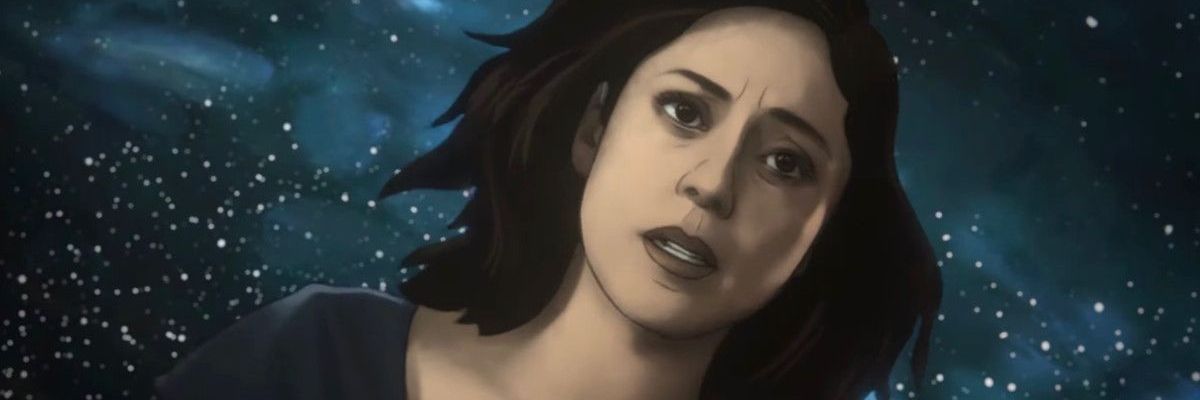


Undone is a series on Amazon Prime composed of 8 episodes that are a little over 20 minutes each. The trailer pitched it as some kind of trippy, time travel mystery. I’m a sucker for that kind of thing. The Matrix meets Father Brown. So, I watched it. I thought it was pretty good. Scratch that. I thought it was really good. Especially because it’s created by a people who have rejected God, but in their art express profound longing for Him. The man who rings the doorbell of a brothel is searching for God. Undone is similar. It’s about our longing for identity, purpose, the supernatural, and redemption. It touches on the right issues, and comes to the wrong conclusions.
I’m not necessarily encouraging Christians to watch it. Most probably shouldn’t. Some probably should. None must. The Apostle Paul read pagan literature. He didn’t just watch Christian movies. And he was so familiar with pagan literature that he was able to quote it back to the Athenians while preaching to them. I’m doing something similar here.
Here’s the part where I say SPOILERS and all that jazz.
Life Under the Sun
Undone follows the life of a millennial woman named Alma. She’s the kind of woman who wants to smash the patriarchy. Quarky. Smart. Funny at times. Generally likable. And suffocating in existential angst.
We are introduced to her as a kind of Quoheleth describing her life similarly to the way Solomon describes life under the sun in Ecclesiastes. After so many vain repetitions, she says, “I’m 28 years old and terrified this is all there is.” Our Creator placed eternity in the heart of man, and the creators of Undone placed eternity in the heart of the show. In the last episode, Alma says to her sister, “Don’t you want there to be more?”
These questions and instincts are ingrained in all of us. And it’s a step in the right direction to embrace them, as this show does. It’s a step away from the unimaginative, sterile, and boring Darwinian naturalism – life under the sun and no more. For well over a century we’ve been trying to convince ourselves that there is no heaven above, no hell beneath. That this is all there is. That you and me baby ain’t nothing but mammals. Nevermind that sensus divinitatis, as the Genevan pastor would say. Ignore that sense of the divine in you. Pay no attention to that seed of religion in you. Pay no attention to the deluge of natural revelation in creation that testifies to your Creator. You want to sin, right? Then this is all there is. Time plus chance plus matter. Believe in science. Believe in yourself! Girl, you are empowered. While Alma is the kind of woman who lives, breathes, and has her being in this kind of atmosphere, her articulations question and begin to reject that worldview. Alma’s honest reflections depict someone wrestling with reality as it is. Someone who has militated against the lies of science and naturalism, even if she isn’t sure that there is something else.
Alma gets into a fight with her sister, Rebecca, and as she is speeding away in her car, angry, and sobbing, she sees her dead father materialize out of thin air for a moment, then she crashes.
She finds herself in the hospital where she sees her father again and talks with him. She begins to experience episodes of sporadic and uncontrollable time travel, visions, and transcendence. Her father essentially asks her to use her gifts to find out who killed him.
Her father begins to train her. To teach her how to use her powers. At one point he says something like, “hearing voices and seeing visions in indigenous cultures is prized. But Western cultures don’t value these things. We institutionalize these people.”
We begin to see glimpses at what Undone is doing here. This casual statement from her father is the main project of Undone. Western culture (Christianity) bad. Paganism good. Put in terms of the zeitgeist: white peepoe bad, dark peepoe good. Of course, this isn’t about race. It’s about religion. And the Anti-Christ spirit of our age has cleverly framed public and political discourse in terms of race as a way of raging against Christ and truth. These things have little to do with race, and everything to do with worship. And this is precisely what Undone is recovering. It is a reawakening of worshiping man. Of man as more than body. A man who is also spirit. That there exists more to life than just what we see under the sun. Particularly, it is an attempt to recover the pagan past. Alma’s journey of learning to harness her supernatural, time traveling powers, is a journey back to her pagan past.
Beautifying The Divorcée
Undone is a social justice warrior version of C. S. Lewis’ or Tolkien’s projects. Lewis and Tolkien showed us how to become pagans again so that we could become better Christians. They taught us that a shaman poking around at chicken guts knows more about the universe than an anthropologist from Cambridge. I think Zizek said somewhere that The Lord of the Rings was the paganization of Christianity.
Undone is doing something similar. Showing us the ugliness of modern naturalism by suggesting the truths of our supernatural pagan history. But unlike Lewis and Tolkien, Undone doesn’t recognize Christianity as the fulfillment of paganism. It appropriates tropes and symbolism from Christianity, as a means of arriving at a more decidedly pagan end.
I remember someone somewhere describe pre-Christ paganism as a fiancée and post-Christ paganism as a divorcée. Christ is the desire of the nations, as Haggai the prophet tells us. And only in Him can those pre-Christian longings and partial truths be fulfilled. Christ, the Bridegroom, has come, and to live life apart from and in contempt of Him now looks something like an embittered divorcée. We know who she is supposed to be married to. We know who her other half is, but she insists on separation. Something similar could be said for modern rabbinic Judaism. Undone attempts to recover the longing for the Bridegroom while denying the Bridegroom. It is set on beatifying the divorcée.
One of the attempts to beautify the divorcée is to affirm the goodness of the supernatural and mystical, and then clump things like schizophrenia in with seeing visions. John saw visions on Patmos. These were good. These were from heaven. Things like schizophrenia are just a modern form of demon possession. Of being tormented by evil spirits. Much like the Gerasene demoniac.
This is right in line with the anti-Christ zeitgeist. Buzzfeed, Huffington Post, any feminist on social media are incessantly telling us that ugly people are beautiful. That fat people are beautiful. That diseases and disabilities are advantages. That sexual promiscuity is virtue. Schizophrenia and other “mental illnesses” are not blessings in disguise. They are burdens and curses that drive you away from reality, not further in to it.
The West has not simply institutionalized anyone that hears voices and sees visions. The West was built by these kinds of men, by supernatural men. We call them Christians. Old men who dreamt dreams. Young men who saw visions. Sons and daughters who prophesied. Monks who fought demons in the desert. Bishops who communicated with the Supreme Being through prayer. Even the master scholastic Thomas Aquinas saw into heaven before he died. And prior to the Reformation, virtually everyone except Gnostics believed in the miracle of the Eucharistic event. That Jesus, through bread and wine, gave his body and blood to us to eat and drink so that we can live forever. The West has only recently been a place of absolute naturalism. The West still doesn’t institutionalize people on grounds that they are hearing voices or something like this. The West has rightly determined that there are good manifestations of the supernatural and bad manifestations of the supernatural. Our judgments may have been off at times, but the category distinction is correct. Undone seeks to shift evil supernatural manifestations into the good supernatural manifestation category.
One more thing on this that Undone does get somewhat right. The West currently, even much of Christianity, is in the midst of attempting to rationalize and medicate spiritual illness like schizophrenia, ADHD, whatever. Non-believers and many Christians alike are seeking natural remedies to supernatural illnesses. Slap some name on it and we have it figured out. There is an element of distorted truth here. When you name something, it is an act of dominion. Adam names the animals. Adam names his wife. God names his people. But we are simply naming various forms of demonic oppression to mask our helplessness. Give the spiritually disordered victim drugs. Turn them into manageable zombies. Voilà! Science is savior.
Undone rightly pushes against the idea that drugs and science are answers to these problems. And rightly seeks to remedy them with spiritual cures. The problem is that they are insisting we look for spiritual answers to these things from our pre-Christian past. After all, they aren’t going to find supernaturally engaged Christians in many traditions, particularly of the cessationist variety, like Reformed and Presbyterians. These Christians, in many ways are basically Deists, and are severely ill-equipped in engaging with the spiritually curious person. They wouldn’t even know where to begin in dealing with demonic possession or supernatural phenomena. The most supernatural thing they engage with is nerd-fiction like Harry Potter books or Marvel movies. They eschew language of a personal relationship with the Lord, and they openly mock charismatics and pentecostals. Real life supernaturalism isn’t their bread and butter. They have strengths to offer, but supernatural guidance isn’t one of them. On the other hand, the charismatic and pentecostal aren’t naturalists or rationalists like the Calvinists are, but they tend to lack the intellectual rigor and discipline which some cessationists do have. Both of these are needed to successfully engage with the supernaturally inclined non-believer.
As the world becomes less and less Christian because of the permitted and encouraged covenant breaking at your local church, we are going to see an increase in demonic activity. This is already happening in numerous ways, but one prominent way is the increase in the number of exorcisms. Exorcists in the Anglican and Roman traditions have experienced an exponential increase in the numbers of demonic possession cases. Joe Rogan and countless others are constantly banging on about the spiritually enlightening experience of DMT and ayahuasca, drugs that are only getting increasingly potent and better at putting the user in contact with the demonic and supernatural realm. People are traveling down to South America to have shamans guide them through their ayahuasca trips. All these things are done to experience some kind of salvation, some kind of spiritual healing. These people are doing these things not because they want to party maaaan. They are doing these things because they are dead inside and they are trying to find God. Undone is another example of this in some sense. It demonstrates an increasing curiosity of our pagan, supernatural, shamanistic past. And it basically commends this way of life as our salvation from the drudgery and horror of existence.
Alma is able to harness her powers and use them to investigate her father’s murder. She does this by leaning in to pagan methods of tapping into the spiritual realm. It isn’t really heavy handed about this, but it’s there (I watched this show a few months ago and am recalling from memory). She continually has difficulty going back in time to the moment of her father’s murder, which involved a car accident. She’s able to get to that moment after talking with a woman, who has native South American ancestry, about dancing for hours in a ritualistic way which helps to bring them in closer contact with their ancestors. It’s something like this. So, Alma tries this and is able to get to that pivotal moment. Again, we have the power of pagan spirituality helping her in a breakthrough moment.
No Lives Matter
What Alma discovers is that her father wasn’t murdered. He was a murderer. He murdered his lab assistant and killed himself. Her father is even shocked as he had blocked the memory himself, and confesses that he isn’t worth saving. Up till this point he had unwittingly deceived himself, and Alma, which is fitting because his name is Jacob. It’s a pretty powerful moment because throughout the show we discover that everyone is soiled, and Jacob is the last person we have hope for in some ways, but then he disappoints, like the rest. Everyone does terrible things. Everyone sins. Everyone is broken. Alma says this about herself and her sister during the heated argument of the first episode which precipitated the car crash. She says to Rebecca, “We’re broken people. And broken people break people.”
Alma pushes her engaged sister, Rebecca, into sleeping with a bar tender. Rebecca feels terrible about it, but then fornicates with another man weeks before the wedding. Alma’s boyfriend, who seems like an overall nice guy, lies about some significant things to Alma out of fear of losing her. Alma’s mother is overbearing and deceptive. She’s also a practicing Roman Catholic, but after things get rough with her daughters, she doesn’t attend church on Easter Sunday. She makes mention of her daughters being her life, and her real religion is depicted when she forsakes the church after she loses Alma. There are hints of Alma’s father being absent. He makes a passing remark about being surprised that Alma doesn’t know how to drive a stick shift. There are strange interactions between him and his lab assistant, Farnaz, which suggest infidelity. But we never know for sure. Everyone is broken.
All of this leads the viewer to think that nobody is worth saving. We have all sinned. We have all fallen short of the glory of God. And not just a little. Not just cursing when you stubbed your toe. But we’ve all made some really terrible decisions that show who we are – monsters. Pharisaical and rebellious. Helpless and broken. Pathetic and in need.
And so Alma then puts a plan of redemption into motion. Her mission shifts to changing the course of events in the past. To prevent her father from going to the lab on a certain night which triggered the murder/suicide. And to create a new timeline which erases their past and gives them a new present reality. She is able to successfully go back in time and change the past to put these things in motion. She returns to the present and only needs to wait at this place in Mexico of religious significance. The alternate timelines are supposed to converge there, and she will be reunited with her father. She drives down there and arrives at this place which is basically like a tomb. So, she is waiting for her father to emerge from this tomb at sunrise on Easter morning, and for a new timeline to come into place which erases her past, and gives her a new future.
This is bursting with Christian imagery. Especially because Rebecca eventually joins Alma. So, you have two women at a tomb waiting for a resurrection. Waiting for their pasts to be erased, a kind of absolution, a forgiveness of sins. Alma and Rebecca are very aware of their own sinfulness, their own brokenness. Alma more so. Alma is explaining to Rebecca what is going to happen, and says to her, “All the stupid things we’ve done will just go away.” And Rebecca responds, “That’s nice.” They both hunger for forgiveness. They know they’ve sinned. And they both want their sins to be absolved. Peter says, “Repent, and let every one of you be baptized in the name of Jesus Christ for the remission of sins!”
Alma not only hungers and thirsts for salvation, but also has father hunger. She has brokenness in her life by the absence of her father. She tries to kill herself when she was younger. Slits her wrist. She misses her dad. At one point she says to her father, “You were supposed to be there.” This is said to her biological father, but I think it also shows her hunger for her Heavenly Father. This woman wants to smash the patriarchy, but in her heart has deep hunger for the Patriarch. For a good Patriarch. Our Father hunger is satisfied in our Heavenly Father. Our spiritual longings are fulfilled in the Holy Spirit. Our brokenness is healed in the Son.
Bath Tubs Are Okay, Too
Undone explores the tension between what you might call the domestic life and the wild life. Alma’s father is a quantum physicists or something like that. He is laser focused on his unusual research. On doing something extraordinary. He’s wants the wild life.
Through Jacob, Undone shows us that the depths of physics intersect with spiritual realities. Something I would agree with somewhat. The language of quantum mechanics sounds just as baffling to me as the language of Trinitarian theology.
Jacob is determined to figure out how to redeem the schizophrenia his mother had. He views it as something that can be controlled and nurtured as a good thing. And he throws himself into scientific work to figure it out, which eventually leads to him practicing ancient pagan rituals and rites, connecting to spiritual realities. So, again, that pagan spirituality is coming through, and coming through in a way that is redemptive.
Jacob represents the kind of person not content with a small, quiet life. He wants there to be more and he wants to figure out what that is and somehow be part of it. This is the wild life. And in its pagan forms, manifests in shamanistic spirituality. But the redeemed form manifests in Christian spirituality.
Alma’s mother, Camilla, is exactly the opposite. She is earthy and domesticated, as women tend to be, and that is a good thing. But it can morph into something bad. As it does with Camilla. There is an ambiguity in the show of whether Alma is simply exhibiting the same kind of schizophrenia her grand-mother had. Or if she is really tapping into time travel and all that. From the point of view of her mother, Alma is losing her mind. And she is strongly insistent on therapy and drugs for Alma. Camilla has a spirituality, but it is a domesticated spirituality, which really doesn’t believe. Camilla means servant of the priest and throughout the show she is actively involved with her church. But when her domestic life with her daughters doesn’t go as planned, and the priest sides with Alma against Camilla, she turns against her priest and her church.
The two different approaches to life are exhibited in a flashback moment when Alma is a child. Her parents take her and her sister to some kind of Aztec ruin or something. And there are the remains of a small concrete pool – the king’s pool. Jacob draws an explanation from Alma that the natives used the pool as some kind of portal to the spiritual realm. Camilla says, “Or maybe it was just a bath tub and that’s okay, too.” And Jacob reluctantly says, “Yeah, that’s okay too.” Alma as a child notices some kind of tension between her parents at that moment.
That tension persists in Alma as an adult. She tells her boyfriend that she doesn’t want to get married and become a boring married couple. She sees married life as a bourgeois banality. It’s the domestic life her mother wants for her. The domestic life her sister is creating for herself with a guy we aren’t supposed to like. But Alma, like her father, has her eyes to the sky.
When Jacob is training her he shows her that if she goes down this supernatural road, she cannot tell her boyfriend, Sam. He wouldn’t understand, and would possibly turn against her. Jacob runs the calculus with her of a life devoid of deep spirituality, of the wildness of the unseen. He says she could get married, have kids, and eventually die, and that’s okay. Bath tubs are okay. And then he says, “Or you could try something different.” She is torn between committing to this supernatural reality, the wild life, or living the normal domestic life. At one point we see her in a bathtub with Sam and she playfully forms his hair into devil horns. This recalls her mother saying, “Bathtubs are okay, too.” The simple life is okay, too. She tells her dad that she just wants to be happy as she remembers the simpler time of her childhood. Jacob says, “Well, happiness can be an escape.”
There are all kinds of perversions of the domestic life and the wild life that we see today. But in Christ, these two approaches to life are redeemed and rightly ordered. Paul can tell the Thessalonians to aspire to live a quiet life, to mind their own affairs, to work with their hands. At the same time he can also tell them that they would be happier if they were single, as he was. That a single person can dedicate themselves fully to the things of God. And that when one does this, they often have a wild life like the Apostle Paul.
There is more to life than what we see under the sun, and both the domestic and wild life can serve their purpose in the Kingdom under the Lordship of Christ. Anything outside of that Lordship will seek solace in something that is a lie and will never bring contentment. This unfortunately is what Undone is doing. They are trading one form of discontentment in for another form. In some ways, a more dangerous form, as it is consciously pressing toward unlawful divination. It is the fulfillment of liberated feminism. Not content with the boring existence of corporate life enslaved to a man not their husband, they will seek spiritual fulfillment, empowerment, and healing from the ancestors of their pagan past, and ultimately enslavement not another man, but to demons.
Scattered Gems
There is much more I could say about Undone, but I’ll leave with you with a few quick remarks about various other things in the show.
This is one is hilarious to me. There is a character who isn’t sufficiently shown to be a bad guy. I think the writers thought they crushed him, but they only revealed their own contempt and hatred toward Christians. It’s Reed, Rebecca’s fiancé. Reed is from a rich, white, Anglo-Saxon, Protestant family. We are specifically told they are Protestants. And Reed is portrayed as a dunce, a boring shell of a man. But if you strip that away, he is the only character who is consistently kind toward everyone. Alma is sarcastic and condescending, but Reed tries to engage in conversation with her anyway. He tries to make a connection with her, asking her about something Alma is interested in. Reed tries to make everyone feel included when they are at a bar together. He is kind toward Alma’s boyfriend. He’s never portrayed doing anything nefarious. He reminded me vaguely of Dostoevsky’s Idiot, who was supposed to be a Messianic figure. A simpleton. Contemptible to the world.
———-
Both Sam and Alma have to learn to speak new languages. Alma has to learn to hear and speak, as she was deaf as a child, but then receives a cochlear implant. Sam learns to speak in a way which eliminates his Indian accent. Undone is about learning to speak a new spiritual language. The language of the unseen.
———-
There is a significant moment where Alma, against the advice of her father, tells Sam everything. That she is seeing her dead father who is teaching her how to time travel. It’s a pretty powerful moment. They ruin it somewhat by adding something that is supposed to be funny, a remark about her brain having large ventricles which biologically explain her adeptness at tapping into spiritual realities. That attempt at humor is misplaced, and setting that aside, it is very powerful. Alma, who is usually joking or sarcastic, is speaking with absolute seriousness and hope that Sam will believe her. It reminds me of Prince Caspian, when Lucy tells her brothers and sister that she saw Aslan, and nobody believes her. But here Sam pretends to believe her for a while, and then ultimately reveals that he believes she is losing her mind.
———-
There is a moment when Camilla’s priest, Father Miguel, is defending Alma. And he says, “Sometimes I talk to someone who looks like they aren’t there.” Camilla, extremely indignant, says, “That is not the same thing!” This is the project of Undone somewhat. To blend evil supernatural manifestations, pagan spirituality, and Christian spirituality all into one transcendent truth. This incident isn’t heavy handed in its syncretism. But coupled with a sermon we hear from the priest earlier, we can surmise that Father Miguel is definitely a liberal Vatican II Catholic. The kind of clergyman liberals love. He is handsome, goes to bat for Alma, and now that I think about, someone else who isn’t really demonized.
———-
Alma and Rebecca have a talk on the stairs right before Rebecca is going to get married to Reed. It is probably the most cringy part of the show. Worst advice ever. There is a better way to be human than what they discuss at this point.
The Conclusion of the Matter
There is a better way to be human. There is a higher spirituality. There is more than life under the sun. The Sun of Righteousness has come and His name is Jesus, Emmanuel. He is the desire of the nations. The governments of the world, both temporal and spiritual now rest on His shoulders. We enter into a supernatural reality with Him by living the life of a saint, whether that is wild or domestic, single or married. By entering into His salvation rest, and all that entails. When all is said and done, the most important thing for a man to do, the most satisfying way to be human is to Fear God and obey His commandments. This is the whole duty of man. It is the fulfillment of paganism. As Chesterton said, “The outer ring of Christianity is a rigid guard of ethical abnegations and professional priests; but inside that inhuman guard you will find the old human life dancing like children, and drinking wine like men; for Christianity is the only frame for pagan freedom.”
Saint Athanasius Video Podcast
Saint Athanasius Audio Podcast
 Feller of Trees