

7. Joy at the End of the Tether: The Inscrutable Wisdom of Ecclesiastes by Douglas Wilson
Ecclesiastes is one of my favorite books and Pr. Wilson does a great job of bringing out its treasures.
“The cycles ordained by God for everything in this fallen and silly world will come around again, and many a millionaire will go white in disbelief. ‘How could this happen?’ Friend, look at the world. How could it not?” (p.45)
Chapter 5, Beautiful in its Time is a great chapter on God’s sovereignty.
“We buck when we hear these things because we are proud. We say that we do not want God’s holiness impugned, but really we do not want our autonomy restricted….If God decrees all things, then I cannot escape Him, not even by plunging myself into all depravity. A man who embraces evil simply finds himself a tool in the hand of the Almighty. A man who rejects evil and follows wisdom finds himself a son in the family of the Almighty. The one option not offered us is that of thwarting and restricting the purposes of God.” (p.47)
Under the sun, we are tempted to despair or grow cynical in our observations of injustice and insanity. But since our hope is not confined to life under the sun, and everything will ultimately be put right at the Judgment, the Christian is free to respond in joy and gladness.
“A man must remember the coming judgment. Repeated success in sinning does not set aside the reality of ultimate justice. While injustice can seem triumph — sometimes good men lose and wicked men win — this apparent triumph is also vanity.
He who has ears to hear, let him hear it. To whom this gift of God has been given, let him enjoy it. The conclusion of the matter? What should a man do in a world of powerful kings and wicked men who look as though they got away with it? He should prepare to make merry; he should enjoy himself — he should eat, drink, and be merry all his days under the sun. Again, Solomon comes to an unexpected conclusion. The fact that men wield power, sometimes unrighteously, is occasion to make merry and enjoy life with anyone else who has been given the gift of this wisdom.” (p. 87)
6. Reformed Catholicity: The Promise of Retrieval for Theology and Biblical Interpretation by Michael Allen and Scott R. Swain
Good for eggheads in the scholarly realm. I find the highly tribalistic expressions of the reformed faith to be incredibly obnoxious, off-putting, and lacking in the Spirit. But the reformed catholic expression I can cheer.
“In the sixteenth and seventeenth centuries, Reformed theologians self-consciously regarded themselves as ‘catholic’—they claimed church fathers such as Augustine as their own; moreover, they saw themselves belonging to the tradition of the great early ecumenical creeds. The Belgic Confession gives a superb example of this: its doctrine of God, the Trinity, and Christ draws deeply upon patristic theology and early ecumenical statements of doctrine. In its significant attention to the sacraments, prayer, and worship, it continues the broadly catholic concern of making these practices central to Christian identity, even as it revises aspects of Roman Catholic doctrine on these points. But the Belgic is also clear about its Protestant identity—on salvation, Scripture, the sacraments, and related topics, it is unmistakably Protestant. This pattern—of drawing upon patristic along with medieval theologians while making fruitful use of the history of biblical exegesis—continued to be a strong pattern in the Reformed tradition for centuries. Thus, it is not surprising that Reformed scholastics continue to develop catholic instincts in their work; for example, William Perkins titled one of his works A Reformed Catholike (1597), and movements such as the Dutch ‘Second Reformation’ drew deeply upon medieval theologians such as Bernard of Clairvaux. It should not surprise us that in the nineteenth century, it was a scholar in the German Reformed tradition, Philip Schaff, who undertook the massive project of first editing and publishing an English translation of the Ante-Nicene, Nicene, and Post-Nicene church fathers. Schaff’s colleague at Mercersburg Seminary, John Williamson Nevin, shared an interest in both the church fathers and reappraisal of Calvin and the Reformed Confessions; this led Nevin to propose a deeply catholic—and yet distinctively Reformed—theology of the incarnation and the Lord’s Supper that shaped his theology of the church. It should not surprise us that at the turn of the twentieth century, a central figure in Dutch Reformed theology, Herman Bavinck, drew deeply upon the church fathers and medieval doctors in his four-volume Reformed Dogmatics—in critical yet appreciative appropriation. Also in the Dutch Reformed tradition, a central advocate of mid-twentieth-century Reformed liturgical renewal was a Mercersburg scholar (Howard Hageman), who speaks of the Reformed tradition as ‘the Catholic Church, Reformed.’ Indeed, as Hageman argues, the Reformed tradition does not claim to ‘restore’ a church that had eclipsed, but to reform the historic catholic church, for even ‘the very name ‘Reformed’ implies continuity. A tree which is reformed is not cut down it is pruned. Just so with our church; one with the historic church of Jesus Christ, it has been purified and restored by that keenest of all instruments, the living word of God.'” (p. 154)
5. Evangelical, Sacramental, & Pentecostal: Why The Church Should Be All Three by Gordon Smith
Huge fan of this expression of Christianity. We practice this at Saint Athanasius Church. But I have yet to find a really good book defending the convergence of evangelical, sacramental, and pentecostal Christianity. This is a good and basic treatment of this three streams expression of being Christian, but I’m still hoping for something better to come along.
“Without active participation and the Spirit’s presence, the liturgy of the Word becomes mere intellectualism; the liturgy of the sacrament becomes mere ritualism.” (p. 93)
“We are not truly pentecostal, in other words, unless we are sacramental, and we are not truly a people who live in the fullness of the Spirit if we are not a people who live by and are feeding on the Word.
Without Word and sacrament, ‘charismatic’ worship descends to mere sentimentality, focused on human felt need, as often as not emotional need. Thus we should have a concern with what might be called the ‘pentecostalization’ of evangelical worship events—the grand stage, the manipulation of emotion, the removal of the table (with the implied downplaying of the sacraments), the removal of the pulpit—replaced by the lectern at best and the chair by the cafe-bistro table at worse (for the pastor’s friendly chat)—so that the visual centerpiece of worship is not the table or the pulpit but the drum set. Yes, all Christian communities surely need to know the very thing that the mystical pentecostal tradition has consistently affirmed: the immediacy of the Spirit in the life of the Christian and the life of the church. But it is not at the expense of either the authority of the Word and of preaching or the vital and defining place of the sacrament. Rather it is necessarily the case that the experience of the Spirit is both the complement to and the very means by which Word and sacrament are present to the church.
And yet having stressed the importance and priority of both Word and sacrament, we can still and we must affirm that there is a witness in the New Testament to something without doubt experienced often in the life of the church that we can and must speak of as ‘unmediated grace.’ We can and need to speak of the immediate gift of the Spirit to the Christian and to the church, a gift that is experienced as divine grace, empowerment, illumination, and comfort. Our experience of the Spirit is not something in the background but rather, a dynamic experience of God’s grace that informs—well, a better word is animates—the life of the Christian and the life of the church.” (p. 117)
4. A Good Man Is Hard To Find and Other Stories by Flannery O’Connor
I think O’Connor’s stories can be better appreciated if you’re familiar with her personal letters. She was devoutly Christian, particularly Roman Catholic. But, to my mind, her stories have a stout Protestant theology of grace pervading them. They are violent deconstructions of the spiritual haughty and prideful. She is an excellent writer and wordsmith, but she makes you work hard at comprehending what she’s doing. In some ways, her short stories are like some of the more bizarre stories of the Old Testament. They are telling us something, but there isn’t always an immediacy to their meaning.
A Good Man Is Hard To Find and Good Country People were my favorites in this collection.
“She would of been a good woman,” The Misfit said, “if it had been somebody there to shoot her every minute of her life.” (p. 23)
3. Everything That Rises Must Converge: Stories by Flannery O’Connor
“Christ the tiger, a phrase in Eliot, is a force felt in O’Connor…In her work we are shown that vices are fathered by our heroism, virtues forced upon us by our impudent crimes, and that neither fear nor courage saves us (we are saved by grace, if at all, though courage may dispose us toward grace).” (Introduction, p. xxx)
The Enduring Chill and The Lame Shall Enter First were my favorites in this collection.
2. The Catholic Religion: A Manual of Instruction for Members of the Anglican Church by Vernon Staley
Helpful summary of the Anglo-Catholic expression of the Christian faith. There is a lot of really good stuff here, and some not so good stuff, too. But I especially liked what he had to say about marriage. It’s interesting because I don’t know of any Anglo-Catholic (or any Anglican) communion which believes this anymore. Staley, writing in 1917, says that only death permits someone to marry again. Anglo-Catholics, like most other Christians, permit divorced Christians to remarry because Christians in every tradition in our pathetic epoch are equally fearful of returning to the ancient ways. Looks like even traditionalists are able to adapt to the demands of modern culture.
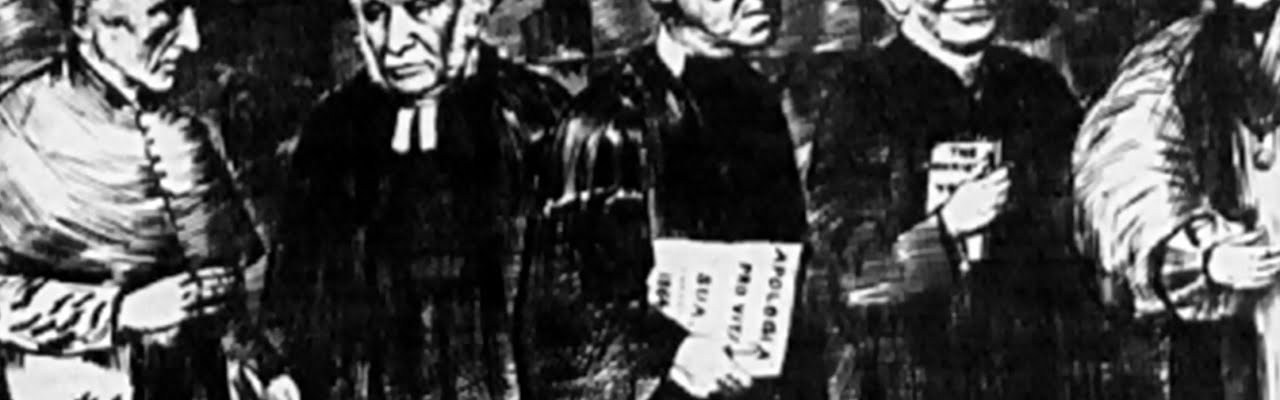
1. The Vision Glorious: Themes and Personalities of the Catholic Revival in Anglicanism by Geoffrey Rowell
Another helpful summary of some of the men behind the Catholic Revival of the 19th century – John Keble, Edward Pusey, John Henry Newman, and others. While I wouldn’t consider myself an Anglo-Catholic, I appreciate many of the things these men were doing and attempting to recover. I especially appreciate the sincere desire to live a holy life that many of them taught and practiced. I also greatly appreciate their push-back against hyper rationalism, which tends to characterize the reformed tradition, something which is both a strength and a weakness of that tribe. The Oxford Movement has the same feel as Chesterton’s Orthodoxy – a kind of exaltation in mystery and the poetic. I have read that Chesterton was channeling Newman often in his own writings. This makes sense to me. Newman said in one of his lectures, “the heart is commonly reached, not by reason, but by the imagination.”
Here are a few passages from the book.
“The genius of the Oxford Movement and the secret of its influence was in its rediscovery of the wholeness of patristic theology, of the reality of sacramental grace, and a refusal, similar to that of Kierkegaard, to confine theology to the domain of the speculative. The ‘Great Mystery’ of transforming grace, of the Divine Indwelling and participation in the Divine Nature, which Pusey saw as central to the life of the Church in the first four centuries, he made central to his own teaching. This was what made ‘real’ and not ‘nominal’ Christians, this distinguished a living theology rooted in worship from rationalist, academic speculation. The scholar must advance in holiness and that in the end was what made Pusey attractive and drew the streams of penitents to his lodgings in Christ Church. ” (p. 96)
“The first note that sounded in Newman’s sermons was a call to holiness, the severe demands of Christian living. Holiness is necessary for future blessedness and heaven would be hell for an irreligious man.” (p. 57)
John Keble on rationalism and the Eucharist:
“Transubstantiation on the one hand…the denial of Christ’s real presence on the other…The two errors in the original are perhaps but rationalism in two different forms; endeavours to explain away, and bring nearer to the human intellect, that which had been left thoroughly mysterious both by Scripture and tradition. They would turn the attention of man from the real life-giving miracle to mere metaphysical or grammatical subtleties, such as our fathers never knew.” (p. 34)
“‘Christianity is not a matter of logical arrangements, or philosophical investigation; much less of rhetorical skill. Not that these things are useless, as talents. But then it should always be remembered, that they are only talents, and will, accordingly, prove worse than useless, except they be united with a rare humility.’ (From Keble’s commonplace book)
The quest for truth, the critical questions, were for Keble always to be conjoined with the search for the good, the quest for holiness, and he was well aware that intellectual pride could be an insuperable barrier to that quest. Faith was a total response of man’s being, not to be reduced to intellectual assent, and faith was evoked not by strident slogans, but sprang from a heart moved to love by the love of God.” (p. 24)
 Feller of Trees