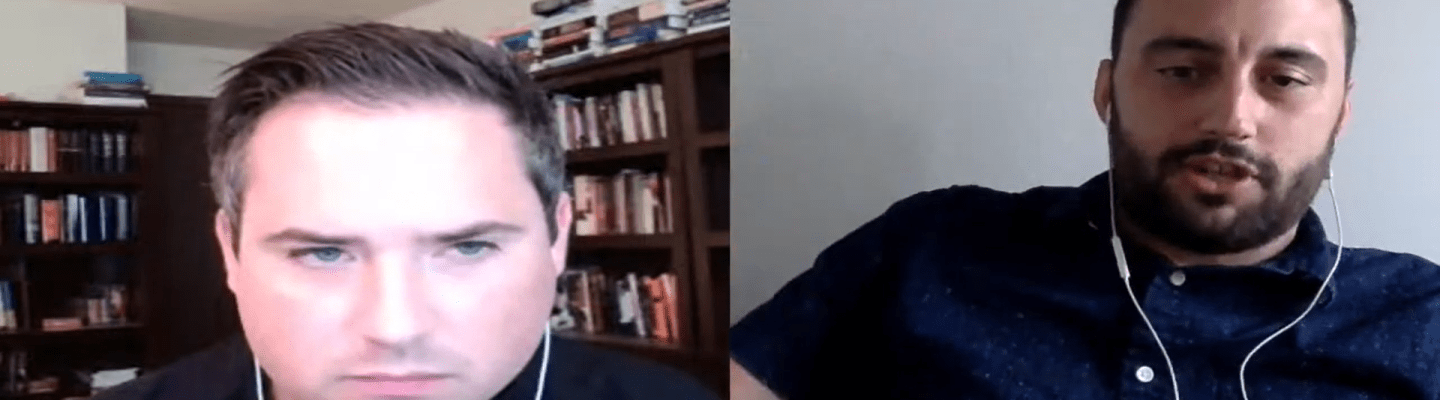


I recently debated Dr. Stephen Boyce on divorce and remarriage over at The Gospel Truth, hosted by Marlon Wilson. I wanted to briefly share a few post-debate thoughts.
Gratitude
I’m grateful that Dr. Boyce took the time to read my book. This allowed us to bypass misunderstandings for the most part and to try and get to the substance of our disagreement. Dr. Boyce was cordial, fair, and even complimentary of the research put into Contra Mundum Swagger and I appreciate that a great deal.
Romanist Sacramental Marriage
Dr. Boyce brought up the sacramental development in the West as a possible problem. That the sacramental understanding of marriage is this alien concept to Scripture that clouded the way Western churchmen thought about marriage, since most Western pastors and theologians treated marriage as indissoluble.
There are a few things going on here.
First, we never got around to defining what a sacramental marriage is. What exactly did Dr. Boyce understand this term to mean and how is it problematic is something we didn’t really get a chance to explore.
Second, I’ve heard this objection before from reformed Christians. There is some worthwhile things to discuss about it. But ultimately, I think it’s a red-herring. Calvinists tend to be very anti-Roman Catholic, and so if you can throw out a scary word like sacramental, it can win points with an anti-Roman Catholic, Calvinistic crowd. If one says, “We don’t believe marriage is a sacrament,” it’s like saying, “We aren’t Roman Catholics.” Of course, Roman Catholics do believe marriage is sacramental and so the association of these things will automatically be off-putting to the anti-Papists.
Third, it’s a red herring because it assumes that the sacramental understanding is this foreign concept, alien to Scripture, that tainted the way the Western tradition has understood marriage. Now, there is some truth to this. So, we have to distinguish, in which ways is sacramental marriage biblical or Apostolic, and in which ways is it not. Under the Roman Catholic understanding there is truth mingled with error, so it creates quite a task of disentanglement.
If one part of a sacramental understanding is that a sacramental marriage is indissoluble because of an ontological bond, then I wouldn’t disagree. I would say this understanding grew out of Scripture, not out of an alien concept imported into the Scripture. Marriage does create an ontological bond. The two will become one flesh is an ontological statement. It is a word from Jesus, a word from the Word, a word from God. And words from God create things. It makes things what they are. This word relates to the being of a man and a woman in marriage. The two become one.
This becomes complicated by the fact that two can become one flesh in an unlawful way. Like Paul mentions in his letter to the Corinthians with joining oneself to a prostitute. But this only reinforces the point. There are ontological bonds being made. I would simply distinguish, some ontological bonds are lawful and others are unlawful. The difference between them is covenant. And then even within covenants, there are lawful and unlawful covenants. And all of these terms and concepts grow out of Scripture. So, when I say lawful and unlawful covenants, I’m not importing alien concepts to the idea of marriage. I’m applying biblical concepts applied through exegesis with wisdom and harmonization. Everyone does this. Whether you think marriage is a contract, covenant, or sacrament. The terms don’t really matter. What matters is figuring out if the meanings of those terms are consonant with Scripture or not, or to what degree they are or are not.
A lawful, covenant, marriage between a man and a woman who are not divorcees is an indissoluble ontological union. In other words, there are certain conditions that have to be met to make a marriage, in my view. There is an oath and a consummation. A marriage by covenant. I don’t intend to develop this here. But Malachi refers to marriage as a covenant. And John Tarwater, in his book Marriage as Covenant, shows that if we look at God-ordained covenants in Scripture, they are indissoluble.
So, if we are saying a sacramental marriage is made when certain conditions are met, then everyone believes in sacramental marriage. Even the most anti-sacramental conservative Christian will say that a marriage has to at least be between a man and a woman. Those are conditions that have to be met.
But, if we are saying that a sacramental marriage has to be one where there is spiritual parity between the spouses, that the church alone has the authority to administer true marriages, then I would disagree. I would disagree because in Scripture marriages of unbelievers are treated as valid marriages. And I believe this is so because marriage is something instituted at creation, and so it is a creational ordinance or institution that all men can participate in. It extends to all of creation rather than only the new creation of the People of God. So, in this sense I would say marriage is not a sacrament. I would part from Rome in this regard.
Evangelical Sacramental Marriage
This leads to the final point on sacramental marriage. Dr. Boyce, toward the end of the debate began to speak of marriage in this last sense. That marriages of unbelievers are different than marriages of believers. That marriages between believers and unbelievers are different and suggesting that they might be invalid. I wasn’t totally clear on what he was saying, but he was using terms like spiritual union and so on. This has layers upon layers of irony. But the irony is not unique to Dr. Boyce. He was simply articulating the cryptic Roman Catholic views of marriage among Evangelicals more broadly. He begins to suggest a view of marriage that is sacramental in the Roman Catholic sense. Not that Rome only can validate sacramental marriage, but that the church can distinguish between different kinds of marriages based on the spiritual maturity, understanding, and belief of the parties involved.
Once one starts to do this, especially in an evangelical setting, it permits divorce and remarriage for everyone. Someone can claim they weren’t really saved in a former marriage. And so they can remarried in a true marriage once they are truly saved. Even if they were baptized at the age of 12 or something. That baptism generally doesn’t mean anything in the evangelical realm. One has to be really saved, right? So, one can simply say they weren’t really saved in their former marriage, which opens up the opportunity for remarrying into a valid marriage. We might call it an sacramentally evangelical marriage.
This is really the same problem in two different forms. In popular evangelicalism your baptism isn’t an objective reality where God binds Himself to you. It’s a subjective expression which can change based on the subject, the person. Marriage isn’t an objective reality where a husband binds himself to his wife. It’s a subjective expression which can change based on the subjects. You fall out of love, leave that person, and get married again. You fall out of love, leave God, and get baptized again. But the reality is that in both cases one is united objectively to either God or their spouse until they die. And if they leave the faith or leave their spouse, they aren’t not Christian anymore, they aren’t not married anymore. They are simply unfaithful. Unfaithful Christian. Unfaithful spouse. Spiritual adultery. Sexual adultery. It is sin in both cases because the covenant is still in place, the bond still objectively exists. It doesn’t dissolve based on the unfaithfulness of the subject.
Live Chat Example
We saw this play out in real time in the live chat during the debate. A woman named Misty wrote, “I was married. I was not saved until after I remarried. We have 4 kids together. My ex-husband is remarried and has 2 kids. Wondering what Jack thinks I should do….” Misty, if you’re reading this, you should separate and remain single. But then a woman named Angie wrote, “I think the Bible says the offending one is the only one that shouldn’t get married again, which obviously, they will because more than likely they are not saved anyways.” So, we see Angie trying to stick to the limited exception view, only the offending spouse can’t get remarried. Then another woman named, and I’m not making this up, StupidWh0reEnergy wrote, “Misty just live your life and be happy.” Then Angie wrote, “That’s not what the Bible says..The offending party, is the one that is committing adultery ..” Then Misty replies, “Angie I was the offending one. I cheated on my first husband. Before I was remarried and saved.” Angie replies, “God saved you where you’re.”
Boom! There it is. God saved you where you are. It doesn’t matter that Misty was the guilty party. She wasn’t really saved, so it doesn’t really count, and God saves her in her adulterous remarriage and she doesn’t have to repent of that remarriage. This is remarkable as it demonstrates this kind of quasi-sacramentalism in the evangelical realm. And that all of this limited exception stuff is pretense and subterfuge. It is a smokescreen that distracts with all this pious language, but at the end of the day everyone can get divorced and remarried. Look at the results. Look at what is permitted in practice. There are loopholes enough for everyone to remain in their adulterous remarriages. That is what is happening here.
What Does Repentance Look Like?
This was seen at another point in the debate where, for the sake of the argument, I granted Dr. Boyce’s premise. That some remarriages are lawful and others are adultery. And I asked him what repentance looked like for someone who, on his own view, was in an adulterous remarriage. To his credit, he pointed out that 1 Corinthians 6:9 says that adulterers do not inherit the kingdom. And that there were many people in adulterous marriages. And I asked him again, what repentance looked like for someone in one of these adulterous remarriages. And he eventually did not give a satisfying answer, in my view. He said that it was a question we need to seriously consider.
And this, I think, also exposes the position as being a smokescreen. Because even in remarriages that he would admit are adulterous, he isn’t willing to say they need to repent by separating. This is huge in my estimation. It reveals the reality on the ground. That even when pastors hold to this limited exception view, they do nothing about the unlawful marriages in their congregations. Even guys like John Piper and Voddie Bauchum who say that remarriage is always adultery do the same thing. That those in adulterous remarriages are not required to repent by separating. This is *the* issue. This is the most important aspect of this entire debate. This is where it matters. This is where the rubber meets the road. This is where our beliefs aren’t just simply empty beliefs, but where beliefs translate into actions, and living faith. Actions speak louder than words. We are living epistles. We present our bodies as living sacrifices. And so when you have these churches that are filled with people who are divorced and remarried, it doesn’t matter how many times John Piper says remarriage is adultery from the pulpit. It doesn’t matter how many times Voddie Bachum says remarriage is adultery from the pulpit. It doesn’t matter how many times Dr. Boyce says remarriage is adultery in some circumstances from the pulpit. If these men are unwilling to use the keys of the kingdom, if they are unwilling to exercise the keys of Peter, they are failing in their duty to lock out the serpent. Failing in their duty to protect the flock. Failing in their duty to save souls. Failing in their duty to save the world. That’s why the world is falling apart right now.
Deuteronomy 24
Deuteronomy 24:1-4 was discussed in the debate. This also is something I have seen reformed pastors and theologians do. Mention they don’t believe marriage is a sacrament to get their anti-Roman bona fides in, then focus on Deuteronomy 24:1-4, like the Pharisees did, and have that passage, understood a certain way, control the interpretation of Jesus and Paul.
In Tony Sargent’s book, The Sacred Anointing: The Preaching of Dr. Martyn Lloyd-Jones, he says this:
“The New Testament is to control the Old, not the Old the New. This is an important axiom, for revelation is progressive, and the final statement is in the New Testament. So the Old can, indeed, be poured through the New in an attempt to expound its meaning…the Old Testament is replete with doctrinal teaching. But the doctrine has to be refined and brought to its fullest expression as it is in the New. So it is important that this hermeneutic is clearly seen and employed by the preacher as he expounds the Scriptures. The New Testament will control the Old. He [Martyn Lloyd-Jones] believed that adherents of reformed theology particularly ran the risk of reversing this order.” (p.227)
Adherents of reformed theology particularly run the risk of reversing this order. Bingo. This is precisely what is happening here with the use of Deuteronomy 24:1-4. If the Pharisees are bringing a debate over Deuteronomy 24:1-4 to Jesus, then we should give priority to how Jesus responds. Jesus doesn’t get bogged down in the minutiae of Deuteronomy 24. He goes back to the created order. And the Pharisees are perplexed as to why Jesus doesn’t stay in Deuteronomy. Jesus says the concession for divorce was given for the hardness of heart. Are we going to let this concession govern our understanding of what Jesus and Paul taught?
Furthermore, in Deuteronomy 24:1-4 we are told that the second marriage defiles the woman. This passage which says the second marriage defiles a woman is the foundational passage for permitting remarriage, on the limited exception view. Does a defiling marriage sound like an affirmation of remarriage to you? No. This is a far cry from commending remarriage, or legitimizing the second marriage. In fact, Peter Craigie, in his commentary says the word defiles suggests adultery. This is precisely what Jesus says it is. A man causes his wife to commit adultery because she gets remarried. This is standard law exposition by the Law-Giver, Jesus. Teaching the law in its fullness. Expanding and clarifying the law. This is why I say the no-remarriage view taught by Jesus is in harmony, even with Deuteronomy 24:1-4.
Also, the only legislative element in Deuteronomy 24:1-4 is the prohibition of return of the woman back to her first husband. This, I believe, is still binding. But it wasn’t this prohibition that was being discussed by Jesus or the Pharisees. They were trying to get Jesus to discuss the descriptive clauses of verses 1-3, not the prescriptive clause of v. 4. The take away from Deuteronomy 24:1-4 is not, she can’t return to her original husband, therefore divorce and remarriage is okay. It isn’t, she can’t return to her husband, therefore the second marriage is legitimate. The takeaway is don’t divorce your wives because when you do, you cause them to commit adultery, their remarriage defiles them. You think you are justified because you issued your wife a certificate of divorce? You are guilty. You are causing her to commit adultery. And the prohibition of return after a remarriage further de-incentivizes the second remarriage. Everything here is screaming don’t divorce and remarry. It is all in that direction. And Jesus states it as such.
And finally, the disciples respond in such a way that suggests Jesus was not siding with the Shammai school in any way. I don’t believe this was adequately addressed by Dr. Boyce. It’s unconvincing to say that Jesus was slightly amending the Shammai position. The disciples’ response do not indicate Jesus was only slightly amending a position they already knew. The disciples say, “If this is the case with a man, it is better not to marry.” Now whether they are speaking of celibacy generally as it relates to the never married, or speaking of celibacy as it relates to a divorcee, they respond in a way that suggests a different conclusion than what was taught by the Shammai Pharisees.
Conclusion
I am absolutely convinced that the limited exception view espoused by Dr. Boyce falls apart in numerous places, and is simply disharmonious with the rest of Scripture. What needs to be remembered constantly is how these things play out in reality. And the reality of the situation is that most of the modern views on divorce and remarriage, whether they are liberal or conservative, all permit divorce and remarriage for any reason at the end of the day. Reformed pastors stand solidly on Deuteronomy 24:1-4 to justify remarriage in their churches. Do you think someone who violates Deuteronomy 24:4 in one of these churches is going to be told to repent of that marriage? On their own view they would say one cannot return to the original spouse. But if someone flouts the rule of the elders, as people regularly do, will those elders call those people to repent by separating? I highly doubt it. The reality is they say things like Dr. Boyce. These are interesting questions that we need to just think about. But that is not what a shepherd does. He doesn’t think about questions while his sheep are being torn to pieces, or wandering off. He acts on their behalf. He protects them, forcibly if necessary. God calls us to be strong and to fight for our flocks, to protect them with our staffs, our keys, our swords, not our thinking caps. If a remarriage is adulterous, then it is unlawful. And we have to say, like John the Baptist said to Herod, you are in an unlawful marriage. And what message did John bring? Repentance. Which means those in unlawful, adulterous, marriages must repent by separating.
 Feller of Trees