

The Assumptions
The Olivet Discourse is the passage of prophecy in Matthew 24, Mark 13, and Luke 21. These passages are popularly understood to be about Jesus’ final coming in our future, about a great tribulation in our future, the rapture, and all those kinds of things. It is a given that these things have not taken place so the postmillennial, preterist understanding is nonsense.
This Generation
But it seems to me that futuristic views of the Olivet Discourse have far more problems, significant ones at that, than the preterist. For example, we are told repeatedly and in numerous ways throughout the New Testament that judgment was coming on the generation of Jesus’ own day. And in the Olivet Discourse, Jesus explicitly says the people he was speaking to would witness whatever it was he was talking about. Jesus ends the bulk of his teachings in the passage by saying, “Assuredly, I say to you, this generation will by no means pass away till all these things take place.” (v. 34, cf. Mark 13:30, Luke 21:32) This statement comes immediately after Jesus had just taught about a great tribulation, the coming of the son of man, the sun darkening, the stars falling, the preaching of the gospel to all the world, and saying things like, “then the end will come.” (v. 14) How could these things have been witnessed by that generation? How could these things have already happened? They clearly have not happened! And so because we bring a ton of assumptions to what these things mean, we change what Jesus says in v. 34 to mean something other than that generation he was speaking to. But there is good, and I think conclusive evidence to understand this passage to mean those things have already taken place.
The preterist view takes v. 34 to literally mean that generation. That it means what it says. That it was the generation Jesus was speaking to who would witness the things he just described. Jesus is emphatic on this point. He says, “Assuredly…this generation will by no means pass away till all these things take place.”
This is reinforced by what Jesus was saying earlier in Matthew 23. The entire chapter, Jesus is trashing the religious leaders. And it ends with Jesus saying they will be judged for killing the prophets, wise men, and scribes sent to them by God. That the blood from Abel to Zechariah would be avenged on that generation. Jesus says to them,
“Therefore you are witnesses against yourselves that you are sons of those who murdered the prophets. Fill up, then, the measure of your fathers’ guilt. Serpents, brood of vipers! How can you escape the condemnation of hell? Therefore, indeed, I send you prophets, wise men, and scribes: some of them you will kill and crucify, and some of them you will scourge in your synagogues and persecute from city to city, that on you may come all the righteous blood shed on the earth, from the blood of righteous Abel to the blood of Zechariah, son of Berechiah, whom you murdered between the temple and the altar. Assuredly, I say to you, all these things will come upon this generation.” (Matthew 23:31-36)
Again, “all these things will come upon this generation.” The blood of martyrs and the prophets from Abel to Zechariah will be avenged on that generation. He says, “that on you may come all the righteous blood shed on the earth.” He directs the statement to those who have killed the prophets and will kill the prophets, which I take to mean the ministers of the gospel in the Apostolic age from 30 – 70 AD, to include the killing of Christ, the Messiah. Also, the word earth in Greek can also be translated as land, and I think land would be a better translation as it is a reference to the prophets killed in the land of God’s people at the time, Palestine. There is a ton of significance tied to the land in the OT, and I believe Jesus is bringing that forward here.
Jerusalem and The Temple
And immediately after this, Jesus laments over Jerusalem. “O Jerusalem, Jerusalem, the one who kills the prophets and stones those who are sent to her! How often I wanted to gather your children together, as a hen gathers her chicks under her wings, but you were not willing! See! Your house is left to you desolate; for I say to you, you shall see Me no more till you say, ‘Blessed is He who comes in the name of the Lord!’ ”(Matthew 23:37-39) And then immediately after this Jesus predicts the literal destruction of the Temple which is a synecdoche for Jerusalem.
“Then Jesus went out and departed from the temple, and His disciples came up to show Him the buildings of the temple. And Jesus said to them, “Do you not see all these things? Assuredly, I say to you, not one stone shall be left here upon another, that shall not be thrown down.” Now as He sat on the Mount of Olives, the disciples came to Him privately, saying, “Tell us, when will these things be? And what will be the sign of Your coming, and of the end of the age?” (vv. 1-3)
“Then as He went out of the temple, one of His disciples said to Him, “Teacher, see what manner of stones and what buildings are here!”And Jesus answered and said to him, “Do you see these great buildings? Not one stone shall be left upon another, that shall not be thrown down.” Now as He sat on the Mount of Olives opposite the temple, Peter, James, John, and Andrew asked Him privately, “Tell us, when will these things be? And what will be the sign when all these things will be fulfilled?” (Mark 13:1-4)
“Then, as some spoke of the temple, how it was adorned with beautiful stones and donations, He said, “These things which you see—the days will come in which not one stone shall be left upon another that shall not be thrown down.” So they asked Him, saying, “Teacher, but when will these things be? And what sign will there be when these things are about to take place?” (Luke 21:5-7)
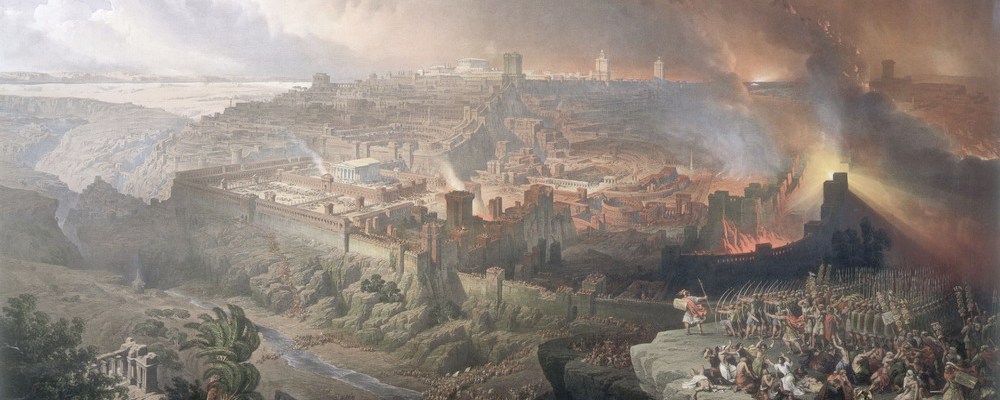
In Matthew 23, Jesus just prophesied judgment on that generation. And here he prophecies judgment on the Temple, specifically. And if we could read between the lines a bit. We see that the disciples are possibly pushing back a bit against Jesus’ prophecy in Matthew 23. Yeah, judgment might come, but at least we got the Temple of the Lord. Look at how beautiful it is. The glory of Jerusalem. Almost an echo of the people in Jeremiah’s day. “Do not trust in these lying words, saying, ‘The temple of the LORD, the temple of the LORD, the temple of the LORD are these.’” (Jeremiah 7:4) And yet, Jesus dashes their hopes in the Temple of the Lord as understood as the Herodian Temple of the First Century in Jerusalem. Jesus says, “Do you see these great buildings? Not one stone shall be left upon another, that shall not be thrown down.” And sure enough in 70 AD, 40 years later, the Temple and Jerusalem was destroyed.
The preterist interpretation most naturally lets the context tell us what the Olivet Discourse is about. Jesus points to the Temple and says this is going to be destroyed. And the disciples ask him when and how it’s going to be destroyed. And the rest of the discourse is Jesus answering those questions. Whenever the disciples ask about the sign of Jesus’ coming and the end of the age, we turn the question into a question about the end of all things, but there is nothing in the passage to indicate this. It is the opposite. It is a question that asks, “When will these things be?” which is a reference to the destruction of the Temple.
Postmillennialists are accused of bringing things to the text that aren’t there. But to me, it seems like the futurists are the ones bringing things that aren’t there. The text is saying, “this generation…this generation…this generation.” The text is saying, “this is about Jerusalem. This is about the Temple.” It’s all right there. It’s all screaming first century fulfillment and context.
Cosmic Deconstruction
Jesus then goes on to describe the destruction of Jerusalem using the same de-creational, cosmically disruptive, apocalyptic language from the prophets of the Old Testament. It is not immediately apparent to us that Jesus is doing this because we live in a Christian culture which is Old Testament illiterate. We haven’t successfully soaked our minds in Old Testament language. We don’t know our Old Testament. We don’t read our Old Testaments. We have New Testament pocket Bibles. Thank God for them. Many people have been saved by reading a Gideon pocket New Testament. But it is kind of strange as it suggests the Old Testament is unnecessary. Imagine the last chapter of Moby Dick as a pocket sized book. Or imagine reading only the last chapter of Les Misérables. It might be really moving and edifying. But there’s a whole story and build up to the last chapter. You’re not going to understand everything fully. The Bible is the same way. We can’t just teleport into the New Testament and expect to fully grasp everything that’s going on. All of Scripture is God-breathed. It is one coherent story with one God speaking through his servants. And the New Testament is what everything in the Old Testament is anticipating. The New Testament is inextricably connected to it. And the more we understand the Old Testament, the better we can understand the New. Recognizing the the prophetic language Jesus uses in the Olivet Discourse is one example of this. The Postmil, preterist, interpretation insists strongly on letting Scripture interpret Scripture.
So, let us proceed by letting the Scriptures do that for us.
Jesus says, “Immediately after the tribulation of those days the sun will be darkened, and the moon will not give its light; the stars will fall from heaven, and the powers of the heavens will be shaken.” (v. 29, cf. Mark 13:24-25, Luke 21:25)
Compare this to Isaiah.
Isaiah says, “The oracle concerning Babylon which Isaiah the son of Amoz saw.” (Isaiah 13:1) He then goes on to say, “For the stars of the heavens and their constellations will not give their light; the sun will be dark at its rising, and the moon will not shed its light.” (Isaiah 13:10) Similar language Jesus uses. And we are explicitly told this prophecy in Isaiah is about Babylon, just like Jesus tells us his prophecy is about Jerusalem. And Babylon is destroyed by the Assyrians in 689 BC by Sennacherib, and 539 BC by Cyrus the Mede (Persians), just as Jerusalem was destroyed by the Romans in 70 AD by Titus.
Isaiah says, “All the host of heaven shall rot away, and the skies roll up like a scroll. All their host shall fall, as leaves fall from the vine, like leaves falling from the fig tree. For my sword has drunk its fill in the heavens; behold, it descends for judgment upon Edom, upon the people I have devoted to destruction.” (Isaiah 34:4-5)
Edom is literally destroyed by Babylon in the early and late 6th Century BC. Decreational, cosmically disruptive, apocalyptic, language associated with specific events in history. Explicitly connected to them in the text, like the Olivet Discourse.
Ezekiel says, “In the twelfth year, in the twelfth month, on the first day of the month, the word of the LORD came to me: ‘Son of man, raise a lamentation over Pharaoh king of Egypt and say to him:” (Ezekial 32:1)
We are explicitly told that this is about Pharoah king of Egypt. He goes on to say:
“When I blot you out, I will cover the heavens and make their stars dark; I will cover the sun with a cloud, and the moon shall not give its light. All the bright lights of heaven will I make dark over you, and put darkness on your land, declares the Lord GOD.” (vv. 7-8)
Egypt is destroyed by Bablyon 605 BC by Nebuchadnezzar.
Decreational, cosmically disruptive, apocalyptic, language associated with specific events in history. Explicitly connected to them in the text, like the Olivet Discourse.
Amos is prophesying mostly against Northern Israel throughout his book, in the time of the kings, prior to their destruction. And he uses the same kind of language.
“‘And on that day,’ declares the Lord God, ‘I will make the sun go down at noon and darken the earth in broad daylight.’” (8:9)
Northern Israel is destroyed by Assyrians in 722 BC.
Decreational, cosmically disruptive, apocalyptic, language associated with specific events in history. Explicitly connected to them in the text, like the Olivet Discourse.
Joel uses the same language.
“The earth quakes before them; the heavens tremble. The sun and the moon are darkened, and the stars withdraw their shining.” (2:10)
“The sun shall be turned into darkness, And the moon into blood, Before the coming of the great and awesome day of the Lord.” (2:31)
Peter applies this prophecy to the time of Pentecost (Acts 2:17-21). It’s possible for the warnings of destruction to be of Israel and Judah prior to their destruction by Assyria and Babylon, like most of the other prophets. Could be a reference to the wars of the intertestamental period. Could be a prophecy of judgments in our future. Perhaps even the Final Judgment. Maybe all of these things. But what the Bible shows us explicitly is that it’s about Pentecost, and I would argue from what we have read above, it’s about the time from Pentecost to Holocaust, as David Chilton puts it, or the time of Pentecost to the destruction of the Jerusalem in AD 70. The point is Joel uses the same decreational, cosmically disruptive, apocalyptic language, and then Peter applies this language to the time of Pentecost, calling it the last days. He is applying this cosmically deconstructive language to that generation, which is in harmony with everything else we have gone over so far.
The point is Jesus uses the same apocalyptic language the OT prophets used when describing the destruction of cities and nations in their immediate future and our past. It isn’t eisegesis to see Jesus doing the same thing here with Jerusalem. This is just basic hermeneutical methods applied. Scripture interpreting Scripture and paying attention to the context. Letting it tell us what it’s in reference to, rather than us telling it what it’s in reference to.
Conclusion
To review, Jesus says the generation of Jews he was speaking to was going to be punished for the blood of the prophets they killed, from Abel to Zechariah, and also the martyrs of the church, and ultimately the crucifixion of Christ. He goes on to explicitly tell us that the Temple was going to be destroyed. He answers the disciples’ question about the sign of his coming and the end of the age with what is the bulk of the Olivet Discourse. In this passage he uses cosmic deconstruction language which is the language of prophets when they speak about the imminent destruction of specific cities and nations. Jesus is doing precisely this. The context of The Olivet Discourse makes these prophecies about Jerusalem and the generation that was alive at the time. Using the Scriptures to interpret the prophetic language of Jesus reinforces this point. The destruction of Jerusalem in 70 AD was the vindication of Christ in time and history. That his prophecies came true, and with a myriad of other things, confirmed His Word and who He was, the Christ. God vindicates His holy ones. “For the LORD will vindicate his people and have compassion on his servants.” (Psalm 135:14) And that is what the Olivet Discourse is about.
We are just getting started here. I’m sure there are more questions you have. We will examine more of the passage in future podcasts. Have a great day, saints. Keep fighting the good fight of faith. Peace of the Lord be with you all.
 Feller of Trees