

11. Prince Caspian by C. S. Lewis
I think we could categorize this story as a return of the King story. Or a return of the Kings and Queens.
Narnia is set far in the future, while the Pevensies have only been gone for a year or something like that. Narnia has become disenchanted and is ruled by King Miraz. Prince Caspian is told as a child about the history of the glory days of Narnia when everything was still enchanted. Caspian says to uncle Miraz, “When everything was quite different. When all the animals could talk, and there were nice people who lived in the streams and trees. Naiads and Dryads they were called. And there were Dwarfs. And there were lovely little Fauns in all the woods. They had feet like goats. And-” “That’s all nonsense, for babies,”said the King sternly.” King Miraz goes on, “There never were those Kings and Queens. How could there be two Kings at the same time? And there’s no such person as Aslan. And there are no such things as lions. And there never was a time when animals could talk. Do you hear?” (pp. 43-44) So, Caspian is growing up in this atheistic, naturalistic Narnia. But he’s being told of the old days by his nurse and then later on by his teacher, who we discover is half dwarf and half human. So Lewis is setting up this naturalistic vs. supernaturalistic tension.
Later Doctor Cornelius, Caspian’s teacher, informs Caspian that his uncle Miraz was a usurper of the crown. “Everyone except your Majesty knows that Miraz is a usurper. When he first began to rule he did not even pretend to be the King: he called himself Lord Protector.” (p. 56) I can’t help but to think Lewis is getting this from Oliver Cromwell’s title during the English Civil War. Perhaps Lewis’ Anglican allegiance is showing through here. Not on the same level as Dante who placed a whole lot of people he didn’t like in hell. But I can’t help but think Lewis is comparing Miraz to the Puritan usurper of the English crown. Just an interesting little slight here.
There is this scene where Caspian, the badger Trufflehunter, the dwarves Trumpkin and Nikabrik discover a cave with Black Dwarves. The Black Dwarves say they will have Caspian as king if he is against the Miraz. They then offer to introduce Caspian to some Ogres and a hag in order to ally with them. Caspian says, “Certainly not.” And the badger says, “We want none of that sort on our side.” Nikabrik disagrees. Trufflehunter says, “We should not have Aslan for friend if we brought in that rabble.” Trumpkin mocks Aslan. And Caspian asks him, “Do you believe in Aslan?” To which Nikabrik replied, “I’ll believe in anyone or anything…that’ll batter these cursed Telmarine barbarians to pieces or drive them out of Narnia. Anyone or anything, Aslan or the White Witch, do you understand?” Truffle hunter replies, “Silence, silence…You do not know what you are saying. She was a worse enemy than Miraz and all his race.” “Not to Dwarfs, she wasn’t.” said Nikabrik. (pp. 70-71) We see this come into play later. Where Nikabrik is incredibly pragmatic and only interested in gaining power and victory with whoever can give it to him.
There’s another great scene where Caspian and his crew encounter a Centaur and his three sons, and they are ready to go to war. The father Centaur is named Glenstorm and he is described as a prophet and he already knows why Caspian has found him. “Long live the King,” he cried. “I and my sons are ready for war. When is the battle to be joined?”
Up till now neither Caspian nor the others had really been thinking of a war. They had some vague idea, perhaps, of an occasional raid on some Human farmstead or of attacking a party of hunters, if it ventured too far into these southern wilds. But, in the main, they had thought only of living to themselves in woods and caves and building up an attempt at Old Narnia in hiding. As soon as Glenstorm had spoken everyone felt much more serious.
“Do you mean a real war to drive Miraz out of Narnia?” asked Caspian.
“What else?” said the Centaur. “Why else does your Majesty go clad in mail and girt with a sword?” (p. 71)
Just a great picture here of the Christian life in general. That we put on the armor of God for a reason. That it isn’t for an occasional skirmish here and there, but for taking back the entirety of the land that has been occupied by the enemy. Whether Lewis intended to or not, I think this is a great portrait of Postmillennialism vs. any other eschatology. Where other eschatologies are essentially content to basically live in hiding, they are resigned to the rule of evil in the world. Contrast this with Postmillennialism which believes that the church will be successful in discipling the nations, and ruling the nations. That Postmillennialism is not resigned to the false assumption that the forces of evil are more powerful than the forces of good. I’m stating the contrast as starkly as possible here. But I think this difference in assumptions seen in the Centaurs and seen in Caspian is something prevalent among Christians. We need more Centaurs!
There is a battle between the remnant old Narnians versus the Telmarines. And they smartly choose where to fight the battle. It’s chosen at Aslan’s How which is where Aslan sacrificed himself on the Stone Table. Which I think is a great portrait. Where Christians ought not to engage battle with our enemies on their terms. We fight on our own turf, with Christ’s sacrifice and resurrection and ascension as the foundation. Otherwise we are fighting a losing battle.
Also of note is that Caspian’s army took a beating at the How. And they were holding on to the hope of the old Kings and Queens of Narnia to return. And when Lucy, Edmund, Susan, and Peter return they aren’t what was expected. There’s a humorous scene (p.91) where Trumpkin who discovers the children first is reticent to admit that he wasn’t expecting children to come, but great warriors. “As it is – we’re awfully fond of children and all that, but just at the moment, in the middle of a war – but I’m sure you understand.” This makes me think of Psalm 8:2: “Through the praise of children and infants you have established a stronghold against your enemies, to silence the foe and the avenger.”
At one point the children and Trumpkin are looking to reconnect with Caspian and his army. And they are somewhat lost, and Lucy sees Aslan and feels like they should follow him. But nobody believes that she saw him, which almost makes her cry. It’s a powerful scene. And so they go a different way instead. Lucy then sees Aslan again while everyone is asleep and speaks with him. And we have this fantastic exchange where Lucy realizes that she should have followed Aslan no matter what, even if her brothers and sisters and the Dwarf guide didn’t see him and didn’t think she was going the right direction.
Lucy shifts the blame on the others and Aslan gives a faint growl to get her to stop from berating them. And Lucy says, “I’m sorry…I didn’t mean mean to start slanging the others. But it wasn’t my fault anyway, was it?”
The Lion looked straight into her eyes.
“Oh Aslan,” said Lucy. “You don’t mean it was? How could I – I couldn’t have left the others and come up to you alone, how could I? Don’t look at me like that…oh well, I suppose I could. Yes, and it wouldn’t have been alone, I know, not if I was with you. But what would have been the good?”
Aslan said nothing.
“You mean,” said Lucy rather faintly, “that it would have turned out all right – somehow? But how? Please, Aslan! Am I not to know?”
A great scene that proves instructive to the Christian life. That sometimes we have to follow Christ when nobody else sees Christ. Which can be a lonely walk. But we must do it anyway. This is one of those principles that everyone seems to affirm, and then when someone actually does it everyone is scandalized.
Aslan then instructs Lucy to go and wake the others up to follow Aslan. And she is told that they won’t see Aslan as first.
Then we read, “It is a terrible thing to have to wake four people, all older than yourself and all very tired, for the purpose of telling them something they probably won’t believe and making them do something they certainly won’t like. ‘I mustn’t think about it, I must just do it,’ thought Lucy.” (pp.124-126) Just excellent.
Once Aslan is able to be seen by everyone, we see this gathering of Narnia creatures come together for a feast and a celebration. They dance through the night and everyone becomes exhausted and sits down to listen to what Aslan had to say next. Then we read this, “At that moment the sun was just rising and Lucy remembered something and whispered to Susan, “I say, Su, I know who they are.”
“Who?”
“The boy with the wild face is Bacchus and the old one on the donkey is Silenus. Don’t you remember Mr Tumnus telling us about them long ago?”
“Yes, of course. But I say, Lu – “
“What?”
“I wouldn’t have felt safe with Bacchus and all his wild girls if we’d met them without Aslan.”
“I should think not,” said Lucy.” (p. 138)
Lewis is doing a risky thing here. Stuff like this is why some fundamentalist Christians denounce Lewis. Bacchus is the Roman version of the Greek god Dionysus – the god of wine and parties. And Silenus is his teacher and friend. The point that Lewis is making here, I think, is that pagan celebration is corrected and harnessed when under the dominion of Christ. Of course, this is a contentious issue. Some Christians think we must be teetotals and can’t dance and play cards and all that. But Lewis certainly didn’t think so, and this is partly his way of saying that.
I think Lewis is making the exact same point as Chesterton at the end of Orthodoxy. “The outer ring of Christianity is a rigid guard of ethical abnegations and professional priests; but inside that inhuman guard you will find the old human life dancing like children, and drinking wine like men; for Christianity is the only frame for pagan freedom. But in the modern philosophy the case is opposite; it is its outer ring that is obviously artistic and emancipated; its despair is within.”
The best scene in this entire book is when Peter, Edmund, and Trumpkin descend into this tunnel and arrive outside a room where they are expecting to meet up with Caspian for the first time. And they hear voices on the other side of the door and so they pause to listen. They hear Nikabrik trying to convince Caspian to give up on waiting for the Kings and Queens of old Narnia to return, and to side with this hag (who is the white witch) and this werewolf. It’s too lengthy of a scene to quote extensively, but it is chilling and an incredible portrait of unbelief and giving up on hope and turning to pragmatic power by basically making a Faustian deal with the devil. I will quote this one terrifying bit from the werewolf when asked who he is.
“A dull, grey voice at which Peter’s flesh crept replied, “I’m hunger. I’m thirst. Where I bite, I hold till I die, and even after death they must cut out my mouthful from my enemy’s body and bury it with me. I can fast a hundred years and not die. I can lie a hundred nights on the ice and not freeze. I can drink a river of blood and not burst. Show me your enemies.” (p. 143)
So, here you have what seems to be formidable ally. And we have extensive arguments from Nikabrik basically saying the Kings and Queens aren’t coming. All the while the Kings and Queens have arrived and the Kings are right outside the door. Eventually the witch attempts to begin her black magic, but then a fight breaks out and Peter and Edmund and Trumpkin barge in to save the day by killing the hag, the werewolf, and Nikabrik.
What’s interesting is you have a woman, a beast, and false prophet. The White Witch, the Werewolf, and Nikabrik. And the return of the king or kings destroys them at the last moment. Perhaps an allusion to the imagery we have in John’s Apocalypse.
Peter makes a remark about Aslan. “We don’t know when he will act. In his time, no doubt, no ours.” (p. 150)
The Narnians ultimately defeat the Telmarines with the help of the trees. And we see Aslan return with the help of Bacchus and the other mythical creatures. There is this transformation of Miraz’s Narnia back to Enchanted Narnia. They encounter a school under Miraz’s rule. We read, “The sort of ‘History’ that was taught in Narnia under Miraz’s rule was duller than the truest history you ever read and less true than the most exciting adventure story.” (p. 170) Lewis, I think, making a slight against modern education here. The school girls under Miraz’s rule are contrasted with Bacchus’ fierce, madcap girls. The Narnian girls are described as having their hair done very tight and ugly having ugly tight collars round their necks and thick tickly stockings on their legs. I’m not sure what Lewis is doing here. It’s this Dionysian/Apollonian dialectic. The wild contrasted with the uptight. And the wild is on the side of Aslan, which I think is pretty cool. Aslan transforms all of creation. It is basically like the Parousia, a coming of the Lord to right all things and to transform the earth totally into a new earth. We see judgments on the wicked. A man beating a boy is turned into a tree. And a group of boys, it is implied, is turned into pigs. Again, this dehumanization idea as a judgment.
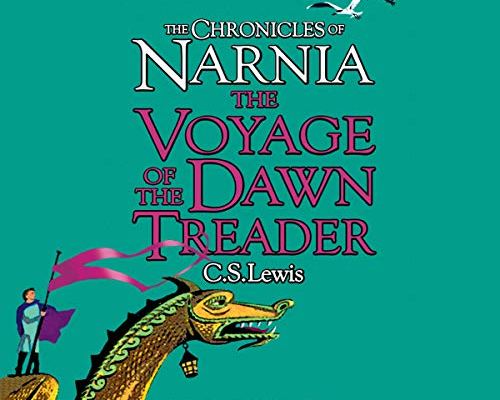
10. The Voyage of the Dawn Treader by C. S. Lewis
This story is an odyssey. In some ways, it’s about Reepicheep going home. The other prominent mission is for Prince Caspian to find these seven lost kings of Narnia by sailing East.
My favorite things about this book are the character transformation of Eustace and the homecoming of Reepicheep. Eustace and Reepicheep are probably my favorite characters in the Narnia Chronicles.
A few funny passages about Eustace.
“There was a boy called Eustace Clarence Scrubb, and he almost deserved it….He didn’t call his Father and Mother ‘Father’ and ‘Mother’, but Harold and Alberta. They were very up-to-date and advanced people. They were vegetarians, non-smokers and teetotallers and wore a special kind of underclothes.” (p. 7)
We’re told Euastace didn’t care about subjects for their own sake. Only for getting good grades.
There’s a humorous scene where Eustace swings Reepicheep around by his tail. “It is not very easy to draw one’s sword when one is swinging around in the air by one’s tail, but he did.” (p. 30) Reepicheep challenges Eustace to a dual. Eustace replies, “I’m a pacifist. I don’t believe in fighting.” (p. 31) Lewis goes on to say, “Eustace (of course) was at a school where they didn’t have corporal punishment.”
We are given snapshots of Eustace’s journal, where he is constantly complaining making himself out to be the victim. Eustace is Howard Zinn writing A People’s History of the United States. Eustace has a bad attitude the entire time. He’s just a rotten kid.
Eustace is eventually turned into a dragon. Another dehumanizing punishment. This ultimately humbles him. Eustace receives a baptism of sorts from Aslan where the “old creature” is torn off of him. It’s a great scene because Eustace keeps trying to take his dragon skin off himself before getting into this pool. But Aslan says he has to take it off for him. And when he does it hurts. Eustace said it felt like his claws dug into his heart. But he was freed from the dragon skin and form and permitted to enter the water. He tells Edmund what happened. And Edmund says it was Aslan who he saw.
“Aslan!” said Eustace. “I’ve heard that name mentioned several times since we joined the Dawn Treader. And I felt – I don’t know what – I hated it. But I was hating everything then. And by the way, I’d like to apologize. I’m afraid I’ve been pretty beastly.”
“That’s all right,” said Edmund. “Between ourselves, you haven’t been as bad as I was on my first trip to Narnia. You were only an ass, but I was a traitor.” (p. 87)
Just a great exchange between the two humbled and transformed boys. Eustace goes on to become a fighter and to become brave. When a giant sea-serpent attacks the ship, he does his best to hack at it with a sword. It doesn’t do much, but he fought. No longer selfish. No longer a pacifist.
There’s a scene where Lucy is looking through this magician’s book. And she sees herself given beauty which resulted in all kinds of wars and strife and envies. It reminded me of the scene in Perelandra where the devil figures gives the Eve figure a mirror to look at her own reflection. I’m not sure exactly how to describe what Lewis is doing with these things, but I think he’s striking at vanity and self-absorption.
There’s a great scene where the Dawn Treader is in a hopeless place. They are lost in an island of pitch blackness and nightmares. Lucy prays a small prayer for Aslan to save them. Then we see this small beam of light and something that looked like a cross, then an airplane, then a kite, then an albatross. It perched on the front of the ship and then flew away as if to guide the ship out of the darkness. Lewis might have been making an allusion to the poem The Rime of the Mariner by Samuel Coleridge, which features an albatross, which is both the sign of blessing, but in the poem becomes a sign of curse or a burden. And of course the cross is both blessing and curse. Christ carrying the curse of sin for us, but then giving us salvation through it as well. I think Lewis might be connecting these ideas here.
We learn that in order to break the spell to free the last lost kings, one has to sail to the end of the world and not come back. And Reepicheep says this is his heart’s desire, to go to Aslan’s country. Later on when there is discussion on how to go forward, Reepicheep says he will go no matter what happens.
“My own plans are made. While I can, I sail east in the Dawn Treader. When she fails me, I paddle east in my coracle. When she sinks, I shall swim east with my four paws. And when I can swim no longer, if I have not reached Aslan’s country, or shot over the edge of the world in some vast cataract, I shall sink with my nose to the sunrise…” (p. 162) Just a fantastic passage here. The desire of Reepicheep’s heart is God, heaven, figured by Aslan’s country. I describe this at Reepicheep’s homecoming.
There so much good stuff I could say about the end of the book, but I’ll just say that once the children encounter Aslan he is in the form of a lamb on a kind of beach/field end of the world type place in front of a fire, and he offers them fish for breakfast. Which of course brings to mind Jesus and Peter and their fish breakfast by the sea. I think Lewis probably used this to tell us that Lucy and Edmund, while unable to return to Narnia, are basically commissioned in a sense, like Peter. “You are too old children,” said Aslan, “and you must begin to come close to your own world now.” “It isn’t Narnia, you know,” sobbed Lucy, “It’s you. We shan’t meet you there. And how can we live, never meeting you?” “But you shall meet me, dear one,” said Aslan. “Are-are you there too, Sir?” said Edmund. “I am,” said Aslan. “But there I have another name. You must learn to know me by that name. This was the very reason why you were brought to Narnia, that by knowing me here for a little, you may know me better there.” (p. 188)
Notice when Edmund asks if Aslan is in our world, Aslan says, “I am” and that he must learn to know him by a different name. That different name is I AM. Just a great scene. Great book. I think this book is a lot of people’s favorites. It certainly ranks high on my list, too.
 Feller of Trees