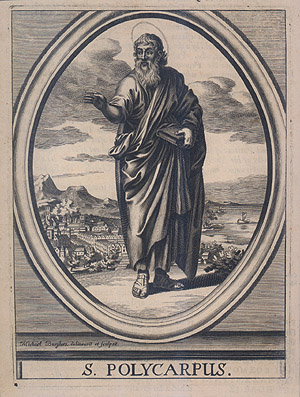


Introduction
Polycarp is one of the three main apostolic fathers, along with Clement and Ignatius. He is reported by Tertullian, Irenaeus, and Jerome to have been a disciple of John, and ordained by John to be the bishop of Smyrna. Smyrna is located on the West Coast of modern day Turkey, by the Aegean sea which is shared with the East Coast of Greece. The city is now called Izmir.
In this letter, Polycarp is described as an apostolic and prophetic teacher, and bishop of the catholic church in Smyrna. The letter is from a Christian eye-witness account of Bishop Polycarp’s martyrdom. It appears it was written by the parishioners of Polycarp’s see in Smyrna. And it’s addressed to another church in the area modern day Turkey and also the entire catholic church.
Polycarp and the Roman Governor
As Polycarp was praying, he was given a vision, and in the vision, he saw his pillow and his head on fire. This was three days before he was arrested. He prophetically said at the time that he would be burnt alive. He was betrayed by a servant and brought into the city where a Roman governor urged him to say Caesar is Lord and to conduct the sacrifices and ceremonies that were believed to ensure the safety and peace of Rome. Polycarp refused. He was thrown out of a chariot and dislocated his leg in the fall. He’s 86 years old at the time. He stood up as if nothing had happened.
Then, for the second time, the Roman governor said to him, “Swear by the fortune of Caesar; repent, and say, Away with the Atheists.” The early Christians were described as Atheists. This is what this governor means when he said this. So, Polycarp turned toward the wicked heathen in the stadium, with a stern countenance, and with his hand waving in their direction, let out a groan toward heaven saying, “Away with the Atheists.” Just incredible.
The governor, for a third time made an entreaty to Polycarp. “Swear, and I will set you at liberty, reproach Christ;” Polycarp declared, “Eighty and six years have I served Him, and He never did me any injury: how then can I blaspheme my King and my Saviour?”
Sidenote: Since the early Christians didn’t consider people to be Christians unless they were baptized, his 86 years of serving Christ is sometimes employed as an apologetic for infant baptism.
The governor, for a fourth time, asked him to swear by Caesar. And Polycarp replied.
“Since you are vainly urgent that, as you say, I should swear by the fortune of Caesar, and pretend not to know who and what I am, hear me declare with boldness, I am a Christian. And if you wish to learn what the doctrines of Christianity are, appoint me a day, and you will hear them.” The proconsul replied, “Persuade the people.” But Polycarp said, “To you I have thought it right to offer an account [of my faith]; for we are taught to give all due honour (which entails no injury upon ourselves) to the powers and authorities which are ordained of God. But as for these, I do not deem them worthy of receiving any account from me.”
Again, just an incredible reply here. Making a judgment on the people that they were not worthy of receiving his account. Fantastic. And yet he gives honor to this governor in offering to give an account to him.
The letter continues:
“While he spoke these and many other like things, he was filled with confidence and joy, and his countenance was full of grace, so that not merely did it not fall as if troubled by the things said to him, but, on the contrary, the proconsul was astonished, and sent his herald to proclaim in the midst of the stadium thrice, “Polycarp has confessed that he is a Christian.” This proclamation having been made by the herald, the whole multitude both of the heathen and Jews, who dwelt at Smyrna, cried out with uncontrollable fury, and in a loud voice, “This is the teacher of Asia, the father of the Christians, and the overthrower of our gods, he who has been teaching many not to sacrifice, or to worship the gods.”
The wicked crowd wanted a lion to be unleashed on Polycarp, but this wasn’t a possibility. So the crowd shouted that he be burnt alive. When Polycarp saw the fire, confirming his prophetic vision, he turned to the faithful that were with him and said to them, “I must be burnt alive.”
Martyrdom for Christ
He was bound to the pyre, and the letter describes him as a ram of sacrifice. The letter says the Jews especially were eager to help build the pyre, bringing wood and the like to burn him. And when the fire was put on the pyre, the flame failed to consume his body, but instead formed a circle around him, as if death itself had a hard time grasping him. Polycarp had to be stabbed by his executioners in order to dispatch his soul. When he was stabbed something like a dove appeared to leave his body. And so much blood came out that it extinguished the flames. The letter said Polycarp looked not like burnt flesh, but like baked bread, and that as he died they could smell the sweet odor of frankincense.
His followers wanted to take his body back with them, but they were denied. The governor didn’t want them worshiping Polycarp like they worshiped Jesus. But the letter says this was said out of ignorance. That Christians love the martyrs and honor them, but that one would betray Christ if they worshiped the martyrs.
The body of Polycarp was eventually burned, and his followers afterward collected his bones and brought them back to a fitting place.
It’s a fantastic account of Polycarp’s faithfulness unto death.
 Feller of Trees