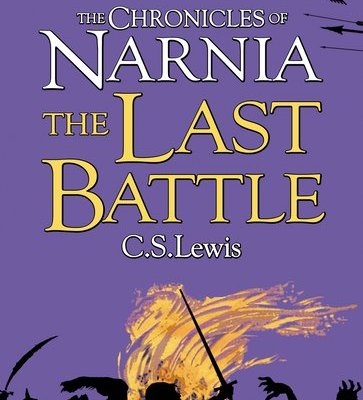


Summary
The Last Battle is the last book in C. S. Lewis’ Narniad. True to the idea of a last battle, it is apocalyptic. Shift the Ape is the last days false prophet. Shift convinces Puzzle, a donkey, to pretend to be Aslan, a kind of Anti-Christ. He deceives the Narnians into believing that Puzzle is Aslan, and that Aslan and Tash are the same god. He breathes lies and deceptions, and foments a great apostasy.
Tirian, a descendant of Prince Caspian, resists the false prophet Shift. He publicly rebuts Shift for saying that Tash and Aslan are the same. He is tied to a tree for speaking truth. Tirian taking on a kind of Messianic image by doing this.
Tirian is eventually freed by Jill and Eustace. They fight for Narnia against the Calormenes and basically lose. The Calormenes take over Cair Paravel. The real god Tash, a Satan figure, is released. He is essentially summoned by Shift. The Calormenes sacrifice their prisoners to Tash. Shift is thrown to Tash and Tash eats Shift. Tirian appears to be on his own, and then he finds himself fighting the general of the Calormenes army, Rishda. He drags Rishda into this small stable, which is where the false Aslan, Puzzle was, then a Calormene soldier was in there, also pretending to be Tash, and then it turns into a portal to a different dimension – to some kind of Narnian version of heaven. Aslan calls on Father Time, the old Narnia is destroyed and the real Narnia is made in its place. Or something like that. I honestly had a hard time following all of it. I should probably read it again to better understand.
On Noble Death
Lewis was a young officer in the first world war. He saw trench warfare at the Somme, which was brutal. I imagine this experience helped form how he wrote about battle.
In the Last Battle, an Eagle informs Tirian that Cair Paravel is filled with dead Narnians and living Calormenes. He also reports that Roonwit the Centaur had died. I think Roonwit the Centaur was a prophet of some sort who warned Tirian that evil was coming to Narnia. He died with an arrow in his side. More Christological imagery. The Eagle says to Tirian:
“I was with him in his last hour and he gave me this message to your Majesty: to remember that all worlds draw to an end and that noble death is a treasure which no one is too poor to buy.” (p. 88)
Fantastic.
We have something similar with Jill, when she realizes she might die in Narnian battle.
“I was going to say I wished we’d never come. But I don’t, I don’t, I don’t. Even if we are killed. I’d rather be killed fighting for Narnia than grow old and stupid at home and perhaps go about in a bath-chair and then die in the end just the same.” (p. 92)
Lewis says something similar in his Learning in Wartime speech. That dying in battle is often quick and painless, whereas dying in peacetime can be protracted and painful. Another great speech from Lewis worth checking out.
Calormene Salvation
One of the more famous and controversial instances in The Last Battle is Calormene Salvation.
Emeth is a noble warrior and a Calormene. He is told that Aslan and Tash are the same, and is willing to see Aslan in this stable where Narnians and Calormenes are being killed. He is willing to die in order to see Tashlan.
“Jill felt like crying when she looked at his face. And Jewel whispered in the King’s ear, “By the Lion’s Mane, I almost love this young warrior, Calormene though he be. He is worthy of a better god than Tash.” (p. 107)
When we get to the heaven scene, we see Emeth. Aslan tells him that all the good that he did in the name of Tash were done for Aslan, and that all the evil that is done in the name of Aslan is done for Tash.
The fact that this is controversial is self-evident. But I don’t think Lewis is endorsing universalism. I don’t think Lewis is endorsing brute works righteousness. I think Lewis is making a comment on the justice and mercy of God, while still affirming that no one comes to the Father except through the Son.
Paul says that the gentiles, through creation are able to know God, and that by nature do the things of the law. But Paul also says that nobody will justified by the law. Everyone is justified by faith, and that faith must be in the True God. Lewis is making a comment on God’s justice and mercy here. While we may not know the final judgments God makes in such cases, we do know that God will be just. And we know that Christ is the exclusive way of salvation for all men.
Further Up, And Further In
Once they are in this final heaven, they realize it’s Narnia, but more real. Lord Digory says, “Listen Peter. When Aslan said you could never go back to Narnia, he meant the Narnia you were thinking of. But that was not the real Narnia. That had a beginning and an end. It was only a shadow or a copy of the real Narnia which has always been here and always will be here: just as our world, England and all, is only a shadow or copy of something in Aslan’s real world.” (p. 159)
Farsight the Eagle says, “Narnia is not dead. This is Narnia.” The new Narnia is described as a deeper country: “every rock and flower and blade of grass looked as if it meant more.”
Lord Digory, again, “You need not mourn over Narnia, Lucy. All of the old Narnia that mattered, all the dear creatures, have been drawn into the real Narnia through the Door. And of course it is different; as different as a real thing is from a shadow or as waking life is from a dream.”
This language is all very Platonic. We can confidently say that Lewis is envisioning some kind Christian Platonism here. And this is confirmed when Lord Digory says, “It’s all in Plato, all in Plato: bless me, what do they teach them at these schools.” (p. 160)
The Unicorn summed up what everyone was feeling. “I have come home at last! This is my real country! I belong here. This is the land I have been looking for all my life, though I never knew it till now…Come further up, come further in!”
This heaven is like an onion, except as you peel the circles get bigger. The inside is bigger than the outside. Narnia is just a cover page. And they began chapter one of a great story that no one on earth has ever read, where the story never ends and each chapter gets better than the last.
All of these ideas are also expressed wonderfully in Lewis’ essay The Weight of Glory, which I would highly recommend. He describes our feelings of nostalgia or beauty as the scent of a flower, but not the flower itself. They act as sign posts to our real home in heaven. If you pair this scene, with The Weight of Glory, and also The Great Divorce, you’ll have nice Trinitarian vision of Lewis’ heaven.
The Little Stable
I found it weird that Lewis chose a little stable as the portal to heaven. It’s a small insignificant stable, but once they entered it, the inside was bigger than outside. It’s described as an onion, but when you peel it it grows larger. And of course Jewel says one can keep going further up, and further in.
And all of this is a comment on The Incarnation. Lucy says that in their world there once was a stable that held something that was bigger than the stable. Christ is the portal to heaven. He is the door. And in Him is the fullness of God, and God is infinite. So, choosing a tiny stable made sense after all.
 Feller of Trees