

Summary
The Silver Chair is about the kidnapping of Caspian’s son, Prince Rilian. Caspian, a Prince in Voyage of the Dawn Treader, is now a king. An old king. A dying king. On his death bed. The story involves Eustace, Jill, who are brought to Narnia, to find and free Prince Rilian from his kidnapper, who turns out to be a witch. This is Eustace’s second time in Narnia, The Voyage of the Dawn Treader being the first. This is Jill’s first time. Another creature from Narnia, named Puddleglum, joins them on their search from Rilian. Puddleglum is a Marsh-wiggle, a humanoid creature that is an amalgamation of all things marsh, frog, duck and so on. He is very earthy, quite literally, and also in his personality. He is very matter of fact.
The Feminine and Luna
When I had read this book originally, I had not read Michael Ward’s Planet Narnia. But I have since. And so, I will only state briefly that Ward’s thesis, if correct, which I believe it is, makes Lewis’ Narnia Chronicle far more rich and thoughtful than I had previously thought. Ward associates The Silver Chair with the goddess Luna. I won’t be bringing in the Lunar donegality directly, but instead I will focus on what I had noticed prior to reading Ward’s Planet Narnia.
However, what I noticed is entirely in line with Lewis’ intended donegality. The ancients associated the moon’s 30 day waxing and waning cycles to the female menstruations cycles. Luna is thought to be an envious planet, as she only gets to rule the night. Whereas Sol is able to rule the day. Her light is derivative. Her role is secondary. And what we see in the Silver Chair is the feminine distortion and hatred of a secondary role, of a submissive role. We see feminine lunacy, to use the lunar etymology. But we also see the feminine faith. Lewis, as always, gives deep and insightful images with respect to these things.
Jill and the Woman At The Well
For example, we see a glimpse of feminine faith at the beginning of the story. It is reminiscent of the woman at the well in John 4.
Jill, recently and tumultuously brought to Narnia, finds herself traveling through the woods. She is parched of thirst and then discovers a stream. She gets ten times thirstier when seeing this beautiful, clear, and bright stream. But she stops because she sees a lion.
“She knew at once that it had seen her, for its eyes looked straight into hers for a moment and then turned away – as if it knew her quite well and didn’t think much of her.” (p. 22)
She becomes paralyzed, thinking if she runs it will chase her, and if she goes for the water it will eat her. And she just remained paralyzed gazing at The Lion. “It seemed like hours,” we’re told. Her thirst gets so bad that she thinks that dying by the mouth of The Lion might not be so bad if she could just get a mouthful of water first.
The Lion says to her, “If you’re thirsty, you may drink.” She’s a bit confused. Doesn’t know who is speaking exactly. And then The Lion says again, “If you are thirsty, come and drink.” At this point she realizes the Lion is speaking.
“Are you not thirsty?” said the Lion.
“I’m dying of thirst,” said Jill.
“Then drink.”
“May I – could I – would you mind going away while I do?” Fantastic. Let me drink, but please go away first.
The Lion answered only with a look and a very low growl. “And as Jill gazed at its motionless bulk, she realized that she might as well have asked the whole mountain to move aside for her convenience. The delicious rippling noise of the stream was driving her frantic.”
“Will you promise not to – do anything to me, if I do come?” said Jill.
“I make no promise, ” said the Lion.
“Jill was so thirsty now that, without noticing it, she had come a step nearer.”
“Do you eat girls?” she said.
“I have swallowed up girls and boys, women and men, kings and emperors, cities and realms,” said the Lion. It didn’t say this as if it were boasting, nor as if it were sorry, nor as if it were angry. It just said it. “I daren’t come and drink,” said Jill. “Then you will die of thirst,” said the Lion. “Oh dear!” said Jill, coming another step nearer. “I suppose I must go and look for another stream then.” “There is no other stream,” said the Lion. (pp. 23-24)
She does the most terrifying thing she’d ever done in her life. Knelt down and scooped up some water in her hand. It was the coolest, most refreshing water she ever drank.
Aslan calls her and they talk. He tells her that he called her and Eustace to Narnia. And she is confused because she didn’t hear anyone call her. They called on Somebody, but she couldn’t remember his name. And that Somebody let them into Narnia.
And Aslan says,
“You would not have called to me unless I had been calling to you,”
“Then you are Somebody, Sir?”
“I am.” (p. 25) A Tetragrammaton reference.
He then sends her on her mission.
The Witch and The Silent Knight
Early in the story the children run into a beautiful queen and her silent knight, which we find out later are the witch and Prince Rilian. Though, the attentive reader will rather easily pick up on this fact before it’s disclosed.
This image itself is a remarkable one. A knight who doesn’t say anything, and is led around by a witch doing her bidding. This is the picture of modern man and his wife. Of modern man and women, generally.
The witch hates children, like women in our time. She sends them to a house of giants who eat children. She is wrapped in thin green linen. Green as poison is how it’s described. She looks like a serpent. Prince Rilian’s Queen Mother is bit by a serpent and dies of the bite. Jill pieces together that the green woman and the serpent were the same person. Later in the story the witch literally turns into a green serpent.
The witch is the Queen of the Underworld as we find out. So, this serpent, witch, queen of the underworld has clear correspondences to Satan. The woman, figurative of Satan, has brought this Knight under her spell. At one point the Knight tells the children about breaking through the underground, to the overworld, and taking the earth as his kingdom “with her to guide me.” (p. 127) The disorder is appalling, and a great picture of many men today. He goes on to say what it will be like when he rules. “In ruling that land, I shall do all by the counsel of my Lady, who will then be my Queen too. Her word shall be my law.” (p. 127) This kind of language reminds me of Marian devotion. I read a Roman Catholic once say that just as marriage is a licit form of the pleasure of sex, Marian Devotion is a licit form of the pleasure of simping. He said this half joking, but half serious. And I think it’s true. I think it’s a perversion that Lewis has marvelously depicted for us here in the snake Queen and her silent kidnapped, under her spell, Knight.
Jill responds to all of this hilariously. “‘Where I come from,’ said Jill, who was disliking him more every minute, ‘they don’t think much of men who are bossed about by their wives.” (p. 128)
“Shalt think otherwise when thou hast a man of thine own, I warrant you,” said the Knight, apparently thinking this very funny. “But with my Lady, it is another matter. I am well content to live by her word, who has already saved me from a thousand dangers.”
Notice the God-like quality this woman has over the Knight. It is reminiscent of Marian devotion. It is a gross perversion of the created order.
“No mother has taken pains more tenderly for her child, than the Queen’s grace has for me.”
Notice he compares himself to a child. Again, Marian devotion.
“Why, look you, amid all her cares and business, she rideth out with me in the Overworld many a time and oft to accustom my eyes to the sunlight. And then I must go fully armed and with visor down, so that no man may see my face, and I must speak to no one. For she has found out by art magical that this would hinder my deliverance from the grievous enchantment I lie under. Is not that a lady worthy of man’s whole worship?”
No one was impressed with this.
“Sounds a very nice lady indeed,” said Puddleglum in a voice which meant exactly the opposite.
They were thoroughly tired of the knight’s talk before they had finished supper. Puddleglum was thinking, “wonder what game that witch is really playing with this young fool.” Scrubb was thinking, “He’s a great baby, really: tied to that woman’s apron strings; he’s a sap.” And Jill was thinking, “He’s the silliest, most conceited, selfish pig I’ve met for a long time.” (p. 128)
The Witch’s Witchcraft
At a pivotal point, the children are being put under the witch’s spell. (pp. 140-143) The witch is lulling them into an enchantment of denial. She is attempting to have them deny the reality and existence of the Overworld and Narnia. She puts a green powder incense into the fire and she begins to play some kind of mandolin, strumming it in a way that made one forget she was strumming it after a few minutes. “There never was such a world, ” said the Witch. “No,” said Jill and Scrubb, “never such a world.” “There never was any world but mine,” said the Witch. “There never was any world but yours,” said they.
This kind of witchcraft which says, “There never was any world but mine,” is seen with the wives of men who don’t permit them to have any friends or any social life out of her own little world. It’s seen in the religion of naturalism or scientism, where the only world that exists is the natural world.
Puddleglum resists the most. He is described as a man who hasn’t had enough air. Puddlglum pushes back saying, “You can play that fiddle till your fingers drop off, and still you won’t make me forget Narnia; and the whole Overworld too. We’ll never see it again, I shouldn’t wonder. You may have blotted it out and turned it dark like this, for all I know. Nothing more likely. But I know I was there once. I’ve seen the sky full of stars. I’ve seen the sun coming up out of the sea of a morning and sinking behind the mountains at night. And I’ve seen him up in the midday sky when I couldn’t look at him for brightness.”
Puddleglum gets the rest of them roused out of their spellbinding drowsiness for a moment. But then the witch re-engages her witchcraft.
“What is this sun that you all speak of? Do you mean anything by the word?”
“Yes, we jolly well do, ” said Scrubb.
“Can you tell me what it’s like?” asked the Witch (thrum, thrum, thrum, went the strings).
“Please it your Grace,” said the Prince, very coldly and politely. “You see that lamp. It is round and yellow and gives light to the whole room; and hangeth moreover from the roof. Now that thing which we call the sun is like the lamp, only far greater and brighter. It giveth light to the whole Overwolrd and hangeth in the sky.”
“Hangeth from what, my lord?” asked the Witch; and then, while they were all still thinking how to answer her, she added, with another of her soft, silver laughs: “You see? When you try to think out clearly what this sun must be, you cannot tell me. You can only tell me it is like the lamp. Your sun is a dream; and there is nothing in that dream that was not copied from the lamp. The lamp is the real thing: the sun is but a tale, a children’s story.”
“Yes, I see now,” said Jilly in a heavy, hopeless tone. “It must be so.” And while she said this, it seemed to her to be very good sense. (p. 142)
Thomas Aquinas would call this talking about God with analogical language rather than univocal language. But what the witch is doing, is appealing to logic and clarity, but really obfuscating and deceiving. She is moving their minds further away from clarity and truth.
Slowly and gravely the Witch repeated, “There is no sun.” And they all said nothing. She repeated, in a softer and deeper voice. “There is no sun.” After a pause, and after a struggle in their minds, all four of them said together. “You are right. There is no sun.” It was such a relief to give in and say it.
“There never was a sun,” said the Witch.
“No. There never was a sun,” said the Prince, and the Marsh-wiggle, and the children. (P. 142)
Then Jill remembers Aslan and brings him up. The Witch does the same thing with Aslan that she did with the sun. They were just imagining a large cat. The Witch is denying reality and making everything smaller, and lesser than what it is. This is the same thing the women in the Unbreakable Trilogy do.
She says these dreams are fitting only for children, but then she shames Prince Rilian for believing in them, and not believing in the real and only world, her world.
Puddlgelum pulls them all out of the spell by putting the fire out partly with his webbed foot. The pain from the fire caused him to think clearly. “There is nothing like a good shock of pain for dissolving certain kinds of magic.” (p. 144)
Fairy and Myth
Puddleglum says that even if Narnia doesn’t exist that it far exceeds the Underworld of the Witch. That he’s on the side of Aslan. And that the imagination of children “licks your real world hollow. “I’m going to live as like a Narnian as I can even if there isn’t any Narnia.” (p. 145) Everyone cheered for Puddleglum as he said this and declared that they were leaving. But then Prince Rilian tells them all to look at the witch.
The Beginning of The End of The Underworld
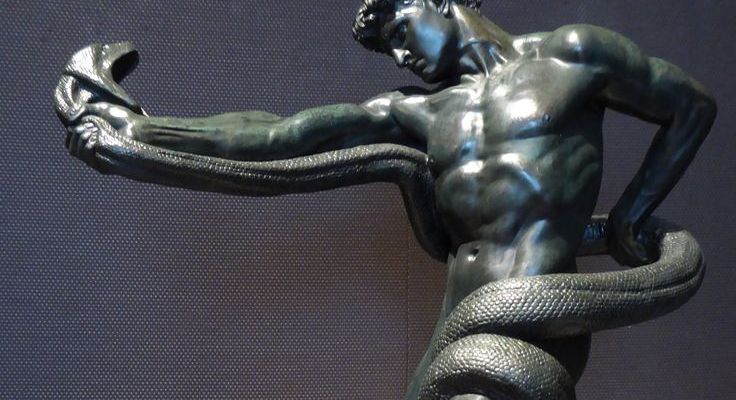
The witch turns into a serpent. She attacks Prince Rilian. The serpent wraps around his legs and his chest, but Rilian is able to grab her throat. And then hacks off her head with the help of Eustace and Puddleglum who also were hacking away. Rilian’s fighting the snake immediately brought to mind Hercules fighting Achelous or Apollo fighting Python or Perseus fighting Medusa. And of course all of these anticipate the reality of Christ crushing the head of the serpent who is Satan.
And after this, her magic began to subside and the Underworld began to fall apart. “We are looking on the end of the Underworld,” Prince Rilian says.
Rilian refuses to put on his armor because it stunk of magic and slavery. But he does take his shield. A kind of Davidic variation here. And his shield morphed from being black to being bright as silver with an emblem of a bright red lion on it. “Doubtless,” said the Prince, “this signifies that Aslan will be our good lord, whether he means us to live or die.” (p. 151-152) He says this again later, “‘Courage, friends,’ came Prince Rillian’s voice. ‘Whether we live or die Aslan will be our good Lord.'” p. 168
I like this episode as it shows forth the end of the underworld with the death of Satan. Satan’s kingdom is beginning to end when Satan is defeated.
The Harrowing of Hades
The death of the witch, the cutting of her head, freed prisoners under the earth – gnomes. And as everyone was being led out of the underworld into the overworld, Golg kept shouting out the good news that the Witch was dead and that four Overlanders were not dangerous. It’s a kind of harrowing of Hades here. Even the four Overlanders perhaps being a variation of the four gospel. The four Overlanders bringing good news.
The Lesson Learned
After Prince Rilian explains what the Witch was trying to do to older and wiser Beasts and Dwarfs, the oldest Dwarf said, “And the lesson of it all is, your Highness,” said the oldest Dwarf, “that those Northern Witches always mean the same thing, but in every age they have a different plan for getting it.” (p. 179)
The Kingly Blessing
Prince Rilian is eventually reunited with his father, King Caspian. King Caspian is very ill on his death bed. They embrace. King Caspian raises his hand to bless Rilian. He then lays his head back and dies. Rilian lays his head on the bed and wept for his father. (p. 185)
It’s a powerful scene that reminds me of the Patriarchal blessing of Isaac to Jacob and Jacob to his sons. Men about to die, giving their blessings to their children who are the new rulers.
The Resurrection of the Dead
The powerful scene continues when Aslan brings them to his Mountain, “high up and above and beyond the end of that world in which Narnia lies.” They walked along a stream crying because of the sadness of the king’s death or because of the beauty of Aslan. Jill couldn’t tell which. And in the stream, lying at the bottom was King Caspian, “dead with water flowing over him like liquid glass.” (p. 187)
Aslan also weeps for Caspian. He calls to Eustace, “Son of Adam, go into that thicket and pluck the thorn that you will find there, and bring it to me.” Eustace obeyed. The thorn was a foot long and sharp as a rapier. “Drive it into my paw, Son of Adam,” said Aslan, holding up his right fore-paw and spreading out the great pad towards Eustace.
“Must I?” said Eustace.
“Yes,” said Aslan.
Then Eustace set his teeth and drove the thorn into the Lion’s pad. And there came out a great drop of blood, redder than all redness that you have ever seen or imagined.
The blood drop goes into the stream over Caspian’s dead body. The somber music that was playing stopped. The king began to change. His white beard got shorter and turned grey, then yellow, and then vanished altogether. His wrinkles smoothed. His eyes opened. And he stood up in front of them laughing, as a very young man. Though Jill couldn’t tell if he was a young man or a boy, because people don’t have ages in that country. Earlier she saw Eustace crying not like a boy, but like an adult.
Caspian gives Aslan a great hug and mighty kiss and Aslan returns his lionly affection to him.
He then begins to talk to Eustace and Eustace is astonished and somewhat startled. He thinks Caspian is a ghost. He asks Aslan if Caspian had died.
“Yes,” said the Lion in a very quiet voice, almost (jill thought) as if he were laughing. “He has died. Most people have, you know. Even I have. There are very few who haven’t.” (p. 188)
Caspian says he would only be a ghost in Narnia, but that one can’t be a ghost in one’s home country. It’s a great scene. It’s a Narnian version of Lazarus from the dead.
The Green Witches of Education and Politics
The book ends with Aslan sending Jill and Eustace back to their school which is called Experiment House, where Lewis says The Head (or Principal) is a woman. (p. 190) It’s found out that she’s not very good at her job. So, they give her another job as an Inspector to interfere with other Heads. And then ultimately they send her to Parliament where she lived happily ever after. So, Lewis ends this book with giving some real parting shots to modern education and politics, and perhaps the Green Witches involved in both.
 Feller of Trees