

Introduction
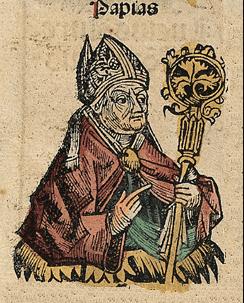
According to Eusebius, Papias was the bishop of Hierapolis, in Phrygia, modern day Turkey. Papias had heard the teachings of the Apostle John, and was a companion of Polycarp. This information is given to us by Polycarp’s disciple, Irenaeus. Eusebius also records some of his work, too. Papias is writing in the late first and early second century.
His surviving work is sparse. And there isn’t much there, so it comes in at the bottom of the list. But there are some things worth noting.
The Voice of the Lord
Papias only wanted to hear Jesus’ teachings.
“For I did not, like the multitude, take pleasure in those who spoke much, but in those who taught the truth; nor in those who related strange commandments, but in those who rehearsed the commandments given by the Lord to faith, and proceeding from truth itself.” (I)
This is interesting because it shows Papias learning about Jesus aurally, that is by hearing. He didn’t have a Bible to read, but instead teachers to listen to.
Papias continues:
“If, then, any one who had attended on the elders came, I asked minutely after their sayings,— what Andrew or Peter said, or what was said by Philip, or by Thomas, or by James, or by John, or by Matthew, or by any other of the Lord’s disciples: which things Aristion and the presbyter John, the disciples of the Lord, say. For I imagined that what was to be got from books was not so profitable to me as what came from the living and abiding voice.” (I)
Not completely sure what he means by this. But it is interesting that he is again eager to hear what the Disciples and Apostles of Jesus have to say about Jesus. Papias is eager to hear that living and abiding voice of Jesus through the Apostles and disciples.
The Kingdom Glorious
Papias gives us an agraphon, a non-canonical word from Christ. It’s a teaching that highlights the glory of the new heavens and the new earth.
“As the elders who saw John the disciple of the Lord remembered that they had heard from him how the Lord taught in regard to those times, and said: “The days will come in which vines shall grow, having each ten thousand branches, and in each branch ten thousand twigs, and in each true twig ten thousand shoots, and in every one of the shoots ten thousand clusters, and on every one of the clusters ten thousand grapes, and every grape when pressed will give five-and-twenty metretes of wine. And when any one of the saints shall lay hold of a cluster, another shall cry out, I am a better cluster, take me; bless the Lord through me.’ In like manner, [He said] that a grain of wheat would produce ten thousand ears, and that every ear would have ten thousand grains, and every grain would yield ten pounds of clear, pure, fine flour; and that apples, and seeds, and grass would produce in similar proportions; and that all animals, feeding then only on the productions of the earth, would become peaceable and harmonious, and be in perfect subjection to man.” (IV)
Irenaeus comments on this passage saying that it is the time of Isaiah prophesied when the wolf would lay down with the lamb.
Papias appears to place the kingdom time as the consummate heavens and earth. The time after the resurrection.
He quotes Paul from his first letter to the Corinthians.
““For He must reign till He hath put all enemies under His feet. The last enemy that shall be destroyed is death.”
Then he adds: “For in the times of the kingdom the just man who is on the earth shall forget to die.” (V)
Semper Virgo?
Lastly, Papias appears to affirm semper virgo, the perpetual virginity of Mary.
He mentions the four different Mary’s in the Gospels, then relates that “James and Judas and Joseph were sons of an aunt (2) of the Lord’s. James also and John were sons of another aunt (3) of the Lord’s.” Rather than talking of James as a brother of Jesus, he mentions James as a cousin.
Some interesting things here. Not saying I agree with all of them. But it gives us insight into the early Church.
 Feller of Trees