

Introduction
Ignatius, bishop of Antioch. Sometimes called Ignatius Theophoros, God-bearer. There’s a tradition that this name had to with his being brought to Jesus as a child to be blessed. But in the letter of his martyrdom, Ignatius tells us that his name is Theophoros because Jesus is in his heart.
There are shorter and longer letters. The shorter ones are the authentic ones and the only ones I will be commenting on. There are several other spurious letters from Ignatius that I will not be commenting on either.
To the Ephesians
Ignatius refers to himself as Theophorous here, and I believe in most if not all of his letters. He mentions twice that he isn’t issuing orders to them as some great person, but as a fellow disciple, a fellow servant, which is certainly the mark of a good leader. He exhorts the Ephesians to follow their bishop, who was Onesimus, the successor to Timothy. This is probably the same Onesimus that Paul writes about in his letter to Philemon. So, we see how close we are to the Apostles. Ignatius also gives the historic three fold order of ministry, whereas in other early writings we see only bishops and deacons. Here we see bishops, deacons, and presbyters.
“Wherefore it is fitting that you also should run together in accordance with the will of the bishop who by God’s appointment rules over you. Which thing you indeed of yourselves do, being instructed by the Spirit. For your justly-renowned presbytery, being worthy of God, is fitted as exactly to the bishop as the strings are to the harp. Thus, being joined together in concord and harmonious love, of which Jesus Christ is the Captain and Guardian, do you, man by man, become but one choir; so that, agreeing together in concord, and obtaining a perfect unity with God, you may indeed be one in harmonious feeling with God the Father, and His beloved Son Jesus Christ our Lord. For, says He, “Grant unto them, Holy Father, that as I and You are one, they also may be one in us.” It is therefore profitable that you, being joined together with God in an unblameable unity, should be the followers of the example of Christ, of whom also you are members.” (Ch. IV)
Ignatius gives strong exhortation to be unified and to be in submission and harmony with the bishop. This emphasis of unity is of course given by Jesus, and Paul, and we see it echoed throughout many of the early fathers. The images he gives here of a harp and choir are beautiful.
Ignatius goes on to warn against forsaking the assembly. Similar to what we saw in Barnabas’ letter.
“Let no man deceive himself: if any one be not within the altar, he is deprived of the bread of God. For if the prayer of one or two possesses such power, how much more that of the bishop and the whole Church! He, therefore, that does not assemble with the Church, has even by this manifested his pride, and condemned himself. For it is written, “God resisteth the proud.” Let us be careful, then, not to set ourselves in opposition to the bishop, in order that we may be subject to God.” (Ch. V)
Just as Paul makes a comparison of a wife submitting to her husband, as the Church does to Christ, Ignatius makes a similar analogy of parishioners submitting to their bishop.
“Now the more any one sees the bishop keeping silence, the more ought he to revere him. For we ought to receive every one whom the Master of the house sends to be over His household, as we would do Him that sent him.” – Ch. VI, Have Respect for the Bishop as To Christ Himself
I believe this is simply echoing what Jesus taught about receiving little ones as you would Himself. Visiting them in jail. Giving them a cup of water. While we should care for the poor, I believe that passage is actually talking about receiving the under-shepherds of Christ’s Church.
Ignatius goes on to mention Onesimus by name.
“And indeed Onesimus himself greatly commends your good order in God, that you all live according to the truth, and that no sect has any dwelling-place among you. Nor indeed do you hearken to any one rather than to Jesus Christ, the true Shepherd and Teacher.” (Ch. VI)
Ignatius again prioritizes the authority of Christ over all. Later he acknowledges Jesus as God.
“There is one Physician who is possessed both of flesh and spirit; both made and not made; God existing in flesh; true life in death; both of Mary and of God; first passible and then impassible,— even Jesus Christ our Lord.” (Ch. VIII)
Ignatius speaks of needing to be sanctified by the Ephesian church and that it is known and celebrated throughout all the world. Ignatius again refers to himself as insignificant, not an important person, etc.
He speaks of the Ephesians loving only God. He praises God for his chains which he calls spiritual jewels. It’s very Pauline. He looks forward dying for Christ, imitating Christ in this way.
He tells us that The Apostle Paul was martyred.
Ignatius views worship as warfare.
“Take heed, then, often to come together to give thanks to God, and show forth His praise. For when you assemble frequently in the same place, the powers of Satan are destroyed, and the destruction at which he aims is prevented by the unity of your faith.” (Ch. XIII)
He goes on to give more Pauline types of encouragements. Love each other. Fear God. Avoid false teachers. And then he gives further exhortation to obey the bishop, and the elders, and ascribes high language to the Eucharist.
“Obey the bishop and the presbytery with an undivided mind, breaking one and the same bread, which is the medicine of immortality, and the antidote to prevent us from dying, but [which causes] that we should live for ever in Jesus Christ.” (Ch. XX)
To The Magnesians
The Magnesians come from the tribe of Magnetes, which Homer mentions in his Illiad. They are located in Thessaly which is in Greece.
Ignatius mentions the bishop by name, Damas, as well as at least two presbyters, Bassus and Apollonius, and one deacon, Sotio. Again, we have the traditional three fold ministry here very early in the game. I would imagine these men were literally all part of the same church in the area of Magnesia.
He exhorts the Magnesians to honor their youthful bishop.
“Now it becomes you also not to treat your bishop too familiarly on account of his youth, but to yield him all reverence, having respect to the power of God the Father, as I have known even holy presbyters do, not judging rashly, from the manifest youthful appearance [of their bishop], but as being themselves prudent in God, submitting to him, or rather not to him, but to the Father of Jesus Christ, the bishop of us all. It is therefore fitting that you should, after no hypocritical fashion, obey [your bishop], in honour of Him who has willed us [so to do], since he that does not so deceives not [by such conduct] the bishop that is visible, but seeks to mock Him that is invisible. And all such conduct has reference not to man, but to God, who knows all secrets.” (Ch. III)
Pretty strong language. He goes on to mention people acting apart from the bishop not possessing a good conscience.
He gives more exhortations to unity and submission.
“I exhort you to study to do all things with a divine harmony, while your bishop presides in the place of God, and your presbyters in the place of the assembly of the apostles, along with your deacons, who are most dear to me, and are entrusted with the ministry of Jesus Christ, who was with the Father before the beginning of time, and in the end was revealed.” (Ch. VI, Preserve Harmony)
“As therefore the Lord did nothing without the Father, being united to Him, neither by Himself nor by the apostles, so neither do you anything without the bishop and presbyters. Neither endeavour that anything appear reasonable and proper to yourselves apart; but being come together into the same place, let there be one prayer, one supplication, one mind, one hope, in love and in joy undefiled. There is one Jesus Christ, than whom nothing is more excellent. Do you therefore all run together as into one temple of God, as to one altar, as to one Jesus Christ, who came forth from one Father, and is with and has gone to one.” (Ch. VII, Do Nothing Without The Bishop and the Presbyters)
He gives usual warnings against Judaizing.
“Be not deceived with strange doctrines, nor with old fables, which are unprofitable. For if we still live according to the Jewish law, we acknowledge that we have not received grace.” (Ch. VIII, Caution Against False Doctrines)
This reminds of the New Perspective on Paul, which is perhaps actually the old perspective on Paul. It appears Ignatius is saying that by abiding by Jewish law, one would be denying the grace of God. This is just appears to be an echo of Paul’s warnings to the Galatians.
He then speaks of no longer observing the Sabbath, as most every early father does, but that Christians instead observe the Lord’s Day.
“If, therefore, those who were brought up in the ancient order of things have come to the possession of a new hope, no longer observing the Sabbath, but living in the observance of the Lord’s Day, on which also our life has sprung up again by Him and by His death—” (Ch. IX, Let us Live With Christ)
He exhorts them to be established in the doctrines of Christ and gives more high language of being in union with the elders and deacons.
“Study, therefore, to be established in the doctrines of the Lord and the apostles, that so all things, whatsoever ye do, may prosper both in the flesh and spirit; in faith and love; in the Son, and in the Father, and in the Spirit; in the beginning and in the end; with your most admirable bishop, and the well-compacted spiritual crown of your presbytery, and the deacons who are according to God. Be ye subject to the bishop, and to one another, as Jesus Christ to the Father, according to the flesh, and the apostles to Christ, and to the Father, and to the Spirit; that so there may be a union both fleshly and spiritual.” (Ch. XIII, Be Established in Faith and Unity)
I’ve quoted so extensively these exhortations regarding the submission because as Americans, and as Protestants, we have such a low regard for submission to church authority. Even those who speak strongly about their wives being in submission to husbands, don’t usually carry that strong language over to being in submission to bishops and presbyters, or to civil magistrates for that matter. We would do well to recover more deference for those that the Lord has appointed over us.
He ends by telling them that he’s writing from Smyrna. That the Ephesians from Smyrna salute them, along with Polycarp, the bishop of the Smyrnaeans, and then he ends by saying, and all the Churches of God salute you.
To The Trallians
Tralles was a city in Phrygia, modern day Turkey.
In this letter he gives more strong and similar exhortations to be subject to the bishop, presbyters, and deacons. He says without them you don’t have a church.
He talks of being within and outside the altar. That those outside the altar are impure, meaning those who operate apart from the bishop, presbyters, and deacons.
He tells them not to listen to those who deny the historicity of Christ. He talks about those who say that Jesus only appeared to suffer. But then he gives this interesting counterpoint. If Jesus only seemed to suffer, or seemed to exist, why am I in chains? He is warning them against the Docetae, or Docetists, those who say that Jesus only appeared to be a man.
To The Romans
He looks forward to seeing the Christians in Rome. He tells them not to pull political strings to save him from martyrdom. He wants to be martyred for the faith.
“For if ye are silent concerning me, I shall become God’s; but if you show your love to my flesh, I shall again have to run my race. Pray, then, do not seek to confer any greater favour upon me than that I be sacrificed to God while the altar is still prepared; that, being gathered together in love, ye may sing praise to the Father, through Christ Jesus, that God has deemed me, the bishop of Syria, worthy to be sent for from the east unto the west. It is good to set from the world unto God, that I may rise again to Him.” (Ch. II, Do Not Save Me From Martyrdom)
Most of the letter is explaining his desire to be with the Lord and to be martyred. I love how he speaks in sacrificial language. Some Protestants have so evacuated the idea of sacrifice from worship and how we live our life that we impoverish ourselves of what it means to actually be a Christian. The early fathers constantly spoke in sacrificial terms. Just like Paul!
To The Philadelphians
More praise of the bishop. Exhortations to maintain union with the bishop. Avoid schismatics.
Strong language against schismatics.
“Keep yourselves from those evil plants which Jesus Christ does not tend, because they are not the planting of the Father. Not that I have found any division among you, but exceeding purity. For as many as are of God and of Jesus Christ are also with the bishop. And as many as shall, in the exercise of repentance, return into the unity of the Church, these, too, shall belong to God, that they may live according to Jesus Christ. Do not err, my brethren. If any man follows him that makes a schism in the Church, he shall not inherit the kingdom of God. If any one walks according to a strange opinion, he agrees not with the passion [of Christ.].” (Ch. II, Avoid Schismatics)
He makes a strong connection between unity and the Eucharist.
“Take heed, then, to have but one Eucharist. For there is one flesh of our Lord Jesus Christ, and one cup to [show forth ] the unity of His blood; one altar; as there is one bishop, along with the presbytery and deacons, my fellow-servants: that so, whatsoever you do, you may do it according to [the will of] God.” (Ch. IV, Have But One Eucharist)
He asks for their prayers. Warns them not to follow Jewish law. More exhortations to unity.
He makes a point about the Old Testament being good, but the New Testament being better. He says, “The priests, indeed, are good. The High Priest is better; to whom the holy of holies has been committed, and who alone has been trusted with the secrets of God.” (Ch. IX, The Old Testament is Good; The New Testament is Better)
He tells them to congratulate the Christians in Antioch because the persecution there had ended.
To The Smyrnaeans
Ignatius makes a point about Christ possessing a body after his resurrection, in contrast to the heretics who denied Christ’s physical body.
He gives instructions in how to treat heretics.
“I give you these instructions, beloved, assured that you also hold the same opinions [as I do]. But I guard you beforehand from those beasts in the shape of men, whom you must not only not receive, but, if it be possible, not even meet with; only you must pray to God for them, if by any means they may be brought to repentance, which, however, will be very difficult.” (Ch. IV, Beware of These Heretics)
Interesting that he calls heretics beasts in the shape of men. Paul says that he fought with beasts in Ephesus (1 Corinthians 15:32). This is almost certainly a reference to heretics, or those who resisted his ministry.
Ignatius says those who confess that Jesus didn’t truly have a body, have denied Jesus, and is already enveloped in death.
All of this comes to a head in the liturgical ceremonial. The heretics deny that Jesus had a body, so they deny the Eucharist is His flesh and blood.
“They abstain from the Eucharist and from prayer, because they confess not the Eucharist to be the flesh of our Saviour Jesus Christ, which suffered for our sins, and which the Father, of His goodness, raised up again. Those, therefore, who speak against this gift of God, incur death in the midst of their disputes. But it were better for them to treat it with respect, that they also might rise again. It is fitting, therefore, that you should keep aloof from such persons, and not to speak of them either in private or in public, but to give heed to the prophets, and above all, to the Gospel, in which the passion [of Christ] has been revealed to us, and the resurrection has been fully proved. But avoid all divisions, as the beginning of evils.” (Ch. VII, Let Us Stand Aloof From Such Heretics)
It’s worth noting that he is telling them to divide from those who are dividers.
He then gives more exhortations to do nothing without the bishop.
“See that ye all follow the bishop, even as Jesus Christ does the Father, and the presbytery as ye would the apostles; and reverence the deacons, as being the institution of God. Let no man do anything connected with the Church without the bishop. Let that be deemed a proper Eucharist, which is [administered] either by the bishop, or by one to whom he has entrusted it. Wherever the bishop shall appear, there let the multitude [of the people] also be; even as, wherever Jesus Christ is, there is the Catholic Church. It is not lawful without the bishop either to baptize or to celebrate a love-feast; but whatsoever he shall approve of, that is also pleasing to God, so that everything that is done may be secure and valid.” (Ch. VIII, Let Nothing Be Done Without The Bishop)
He gives more exhortations to honor the bishop. That those who do things in secret apart from the bishop are serving the devil.
Again, strong language here. A good palliative to our bristling against authority.
It’s worth noting the obvious, because people love to chime in with their reminders of the obvious. Submission to human authority is not absolute. The only person with absolute authority is God, but these reminders are exceedingly beneficial for Protestants and Americans to hear.
To Polycarp
Ignatius gives Polycarp Pauline advice. Pray without ceasing. Persevere in unity.
He gives very good pastoral counsel, too.
“If you love the good disciples, no thanks are due to you on that account; but rather seek by meekness to subdue the more troublesome. Every kind of wound is not healed with the same plaster. Mitigate violent attacks [of disease] by gentle applications. Be in all things “wise as a serpent, and harmless as a dove.” For this purpose you are composed of both flesh and spirit, that you may deal tenderly with those [evils] that present themselves visibly before you. And as respects those that are not seen, pray that [God] would reveal them unto you, in order that you may be wanting in nothing, but may abound in every gift. The times call for you, as pilots do for the winds, and as one tossed with tempest seeks for the haven, so that both you [and those under your care] may attain to God. Be sober as an athlete of God: the prize set before you is immortality and eternal life, of which you are also persuaded. In all things may my soul be for you, and my bonds also, which you have loved.” (Ch. II)
Here Ignatius encourages Polycarp to love not only good parishioners, but the more troublesome. That every body needs to be addressed differently, uniquely, like different wounds are healed differently. He encourages gentleness. He speaks of obvious evils and unseen evils, and to pray that God would reveal them. He speaks of Polycarp’s role as a pilot, the captain of a ship, with the goal of reaching immortality and God.
Great imagery and counsel here.
He goes on to give an excellent exhortation to remain firm against false teachers.
“Let not those who seem worthy of credit, but teach strange doctrines, fill you with apprehension. Stand firm, as does an anvil which is beaten. It is the part of a noble athlete to be wounded, and yet to conquer. And especially, we ought to bear all things for the sake of God, that He also may bear with us.” (Ch. III)
He exhorts him to look after widows. He repeats the same line about bishops. Don’t let anyone do anything without the bishop’s consent, and he tells Polycarp not to do anything without God’s consent. He encourages the assembly to be frequent, by which he most certainly means worship services.
He tells Polycarp to treat male and female slaves well, but to not let them get puffed up and conceited. He also says to not use the public funds to free these slaves, lest they became slaves of their own desires.
He commends celibacy, but tells those who are celibate not to boast about it. He gives instruction to the married, to be content with their husbands and wives and echoes Paul’s instructions here. He does say that marriages ought to have the approval of the bishop, so that it is according to the Lord and not after our own lust.
He says to give heed to the bishop. As this is addressed to Polycarp, I wonder if at this time he wasn’t the bishop, or he had a bishop overseeing himself, or perhaps this portion of the letter would have been understood to be directed at those under Polycarp’s oversight. He also gives the usual exhortations to submission to and unity with the presbyters and deacons as well.
He ends the letter by asking Polycarp to send messengers to adjacent churches and particularly to Antioch. He says their prayers were the means by which Antioch received recent peace, meaning the persecutions had ended.
Martyrdom
The martyrdom by Ignatius is recorded by eye witnesses of the event. Ignatius is brought before Trajan in Antioch for refusing to sacrifice to the demons. I’ll summarize the exchange.
Trajan calls him evil. Ignatius says nobody should call him evil because Christ has purged all his servants of evil spirits, but if Trajan calls him wicked because he’s an enemy of the demons that Trajan worships, Ignatius says, “Ok. You can call me wicked in that case.”
Trajan asks him, “Who is Theophorus?”
Ignatius says, “He who has Christ within his breast.” In other words, he who has accepted Jesus into his heart.
Trajan asks Ignatius something like “Don’t you know we have the gods in our minds? They benefit us in fighting our enemies, no?”
Ignatius says, “You’re mistaken. The demons of the nations are not gods. There is only one God who made everything.”
Trajan asks, “You mean the one who was crucified under Pontius Pilate?”
Ignatius says, “The one who has crucified my sins, and who has put all evil and the Devil under the feet of those who carry Him in their heart.”
Trajan asks, “So you carry within you He who was crucified?”
Ignatius says, “Truly so!”
A truly amazing exchange. You can hear the sarcasm in Trajan’s voice, and Ignatius steel resolve and sincere proclamation of Truth.
Then Trajan pronounced that Ignatius be bound and taken to Rome to be devoured by beasts. Ignatius replied with exuberant thanks to God that he would suffer martyrdom like the Apostle Paul.
On his way to Rome, he was met by the bishops, presbyters, and deacons of the cities. Many of them were seeking to receive a spiritual gift from Ignatius. Ignatius also sent his letters to the churches during this time.
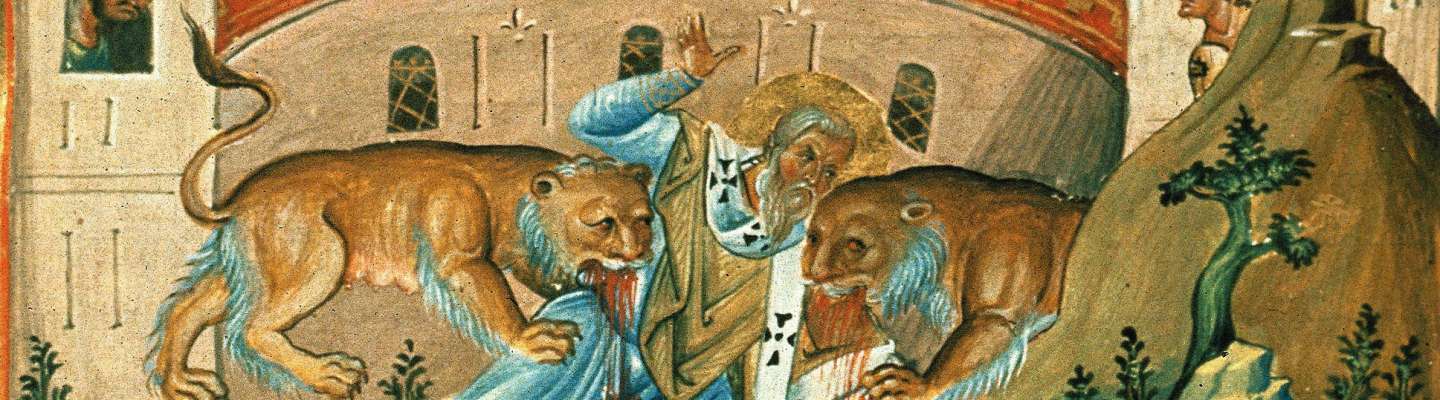
He was fed to the beasts. Very few details are recorded about it. His bones were wrapped in linen and returned to Antioch.
The eye-witnesses of these things tell us that they all saw a vision of Ignatius praying for them and with the Lord. They then rejoiced and gave thanks.
St. Ignatius was a great bishop. I hope we begin to see more bishops like him in our own day.
 Feller of Trees