

The Way of Poetry
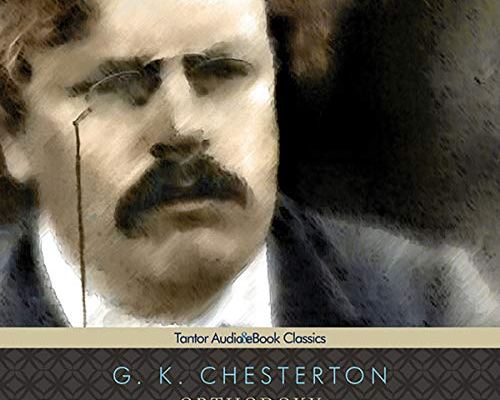
Orthodoxy is one of my favorite books. I read it 12 years ago, and this past year I listened to it. It still stands up as a great book, and still remains one of my favorites.
In 2011, I was diving deep into philosophy and apologetics and things like this. I was in the Marines, but spending much of my free time reading philosophy and theology. While I was in Afghanistan, another Marine, and friend from college, sent me Orthodoxy. And it was a relief. I had gotten so entrenched in trying to figure everything out that I didn’t even realize my intellect was almost suffocating. And reading Orthodoxy, was like Chesterton coming along, placing his hand on my shoulder and saying, “Hey man, mystery is okay. It’s more than okay. Mystery is good. It is glorious.” What a relief! Chesterton won me over to the poetic. The way of poetry we might say. And I have held on to this way ever since.
Chesterton says, “Poetry is sane because it floats easily in an infinite sea; reason seeks to cross the infinite sea, and so make it finite. The result is mental exhaustion… To accept everything is an exercise, to understand everything a strain. The poet only desires exaltation and expansion, a world to stretch himself in. The poet only asks to get his head into the heavens. It is the logician who seeks to get the heavens into his head. And it is his head that splits.” (Orthodoxy, Ch. II, The Maniac)
The Maniac and The Mystic
The entire books if phenomenal, but his chapter on The Maniac remains salient in my mind. In it he launches a devastating salvo against what I would call improperly formed reason or hyper-rationality. And instead, extols the virtues of mystery. Not as an alternative to reason, but as reason in its proper place. After all, Chesterton loved Aquinas.
“Mysticism keeps men sane. As long as you have mystery you have health; when you destroy mystery you create morbidity. The ordinary man has always been sane because the ordinary man has always been a mystic. He has permitted the twilight. He has always had one foot in earth and the other in fairyland. He has always left himself free to doubt his gods; but (unlike the agnostic of today) free also to believe in them. He has always cared more for truth than consistency. If he saw two truths that seemed to contradict each other, he would take the two truths and the contradiction along with them. His spiritual sight is stereoscopic, like his physical sight: he sees two different pictures at once and yet sees all the better for that. Thus he has always believed that there was such a thing as fate, but such a thing as free will also. Thus he believed that children were indeed the kingdom of Heaven, but nevertheless ought to be obedient to the kingdom of earth. He admired youth because it was young and age because it was not. It is exactly this balance of apparent contradictions that has been the whole buoyancy of the healthy man. The whole secret of mysticism is this: that man can understand everything by the help of what he does not understand.” (Orthodoxy, Ch. II, The Maniac)
Fantastic beyond words. I think that the rational Maniac is a victim of his own arrogance and pride. It takes humility to say I don’t know. It takes going low to be able to comprehend and rest in what is high.
Aliens and The Heart
In a later chapter, exploring the paradoxes of Christianity, he gives a very helpful illustration highlighting the flaw in hyper-rational maniacs.
“The real trouble with this world of ours is not that it is an unreasonable world, nor even that it is a reasonable one. The commonest kind of trouble is that it is nearly reasonable, but not quite. Life is not an illogicality; yet it is a trap for logicians. It looks just a little more mathematical and regular than it is; its exactitude is obvious, but its inexactitude is hidden; its wildness lies in wait. I give one coarse instance of what I mean. Suppose some mathematical creature from the moon were to reckon up the human body; he would at once see that the essential thing about it was that it was duplicate. A man is two men, he on the right exactly resembling him on the left. Having noted that there was an arm on the right and one on the left, a leg on the right and one on the left, he might go further and still find on each side the same number of fingers, the same number of toes, twin eyes, twin ears, twin nostrils, and even twin lobes of the brain. At last he would take it as a law; and then, where he found a heart on one side, would deduce that there was another heart on the other. And just then, where he most felt he was right, he would be wrong.” (Ch. VI, The Paradoxes of Christianity)
The Paradoxes of Christianity
Orthodoxy is an apologetic for Christianity. Chesterton walks us through his own journey of thinking about Christianity and its apparent paradoxes.
He says, “the more I considered Christianity, the more I found that while it had established a rule and order, the chief aim of that order was to give room for good things to run wild.” (Orthodoxy, Ch. VI, The Paradoxes of Christianity)
Ungracious Grace
He ends the book with this fantastic passage about divine grace. It has stayed with me through all these years, and it is immensely relevant to the lawless and soft times we live in.
“The strongest argument for the divine grace is simply its ungraciousness. The unpopular parts of Christianity turn out when examined to be the very props of the people. The outer ring of
Christianity is a rigid guard of ethical abnegations and professional priests; but inside that inhuman guard you will find the old human life dancing like children, and drinking wine like men; for Christianity is the only frame for pagan freedom. But in the modern philosophy the case is opposite; it is its outer ring that is obviously artistic and emancipated; its despair is within.” (Orthodoxy, Ch. IX, Authority and the Adventurer)
Great book. Highly recommend.
 Feller of Trees